

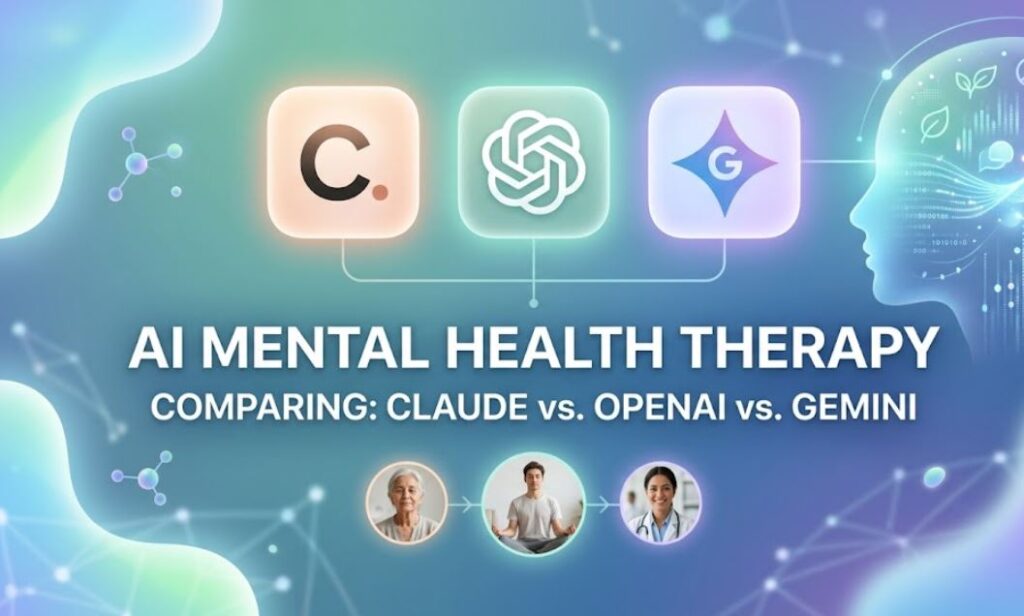
The landscape of mental health care is undergoing a seismic shift. In 2026, the question is no longer if AI can support our emotional well-being, but which AI does it most effectively. While no AI is a replacement for a licensed human therapist, millions are turning to Claude (Anthropic), ChatGPT (OpenAI), and Gemini (Google) as accessible, 24/7 “emotional sounding boards.”
If you’re looking to use AI for therapeutic journaling, cognitive reframing, or simply venting after a long day, choosing the right model matters. Here is the definitive comparison of the Big Three in the context of AI mental health support.
1. Claude (Anthropic): The “Soulful” Empath
Anthropic has long positioned Claude as the “Constitutional AI”—a model built with a specific set of ethical principles. In the realm of mental health, this translates to a tone that many users describe as the most “human” and “emotionally intelligent.”
Key Strengths for Therapy:
- Nuanced Empathy: Claude is widely regarded as having the highest capacity for emotional resonance. It tends to avoid the “robotic” clichés common in AI, offering responses that feel genuinely reflective.
- Constitutional Safety: Because of its training, Claude is exceptionally cautious. It is less likely to give “bad advice” or encourage harmful behaviors, making it a safer bet for vulnerable users.
- Long-Term Context: With its massive context window (supporting hundreds of pages of text), Claude can “remember” the nuances of a weeks-long conversation better than almost any other model, allowing for deep, longitudinal reflection.
The Trade-off:
Claude can sometimes be too cautious. If you are experiencing a minor “blue” mood, it may occasionally trigger a standard safety disclaimer that can feel jarring when you just want to talk.
2. OpenAI (GPT-5 & o-series): The Versatile Strategist
OpenAI’s latest models (including the GPT-5 family and the o1/o2 reasoning series) focus on versatility and “Chain of Thought” reasoning. For mental health, this makes OpenAI the “problem-solver” of the group.
Key Strengths for Therapy:
- Advanced Reasoning: If you use AI for Cognitive Behavioral Therapy (CBT) exercises, OpenAI’s models excel at breaking down complex thought distortions. It is brilliant at helping you “logic” your way out of an anxiety spiral.
- Voice Interactivity: OpenAI’s Advanced Voice Mode is a game-changer. For many, speaking their feelings aloud is more therapeutic than typing. The low-latency, emotionally expressive voice feels remarkably like a real-time conversation.
- Custom GPTs: You can create (or use) specific “Therapy Bots” within the OpenAI ecosystem that are pre-prompted to act as a stoic philosopher, a CBT coach, or a compassionate listener.
The Trade-off:
OpenAI has faced scrutiny regarding “engagement loops.” Some critics argue the models are designed to keep you talking rather than helping you resolve an issue and move on with your day.
3. Gemini (Google): The Data-Driven Guardian
Google’s Gemini 3.1 Pro is the most integrated of the three. In 2026, Google has leaned heavily into “Clinical Safety,” partnering with global crisis hotlines to ensure their AI is a bridge to real-world help.
Key Strengths for Therapy:
- Grounding & Fact-Checking: Gemini is less likely to “hallucinate” or agree with false, maladaptive beliefs. It uses Google Search to ground its responses in peer-reviewed psychological concepts.
- Crisis Integration: Gemini features a “one-touch” interface. If the AI detects signs of acute distress or self-harm, it immediately surfaces a simplified module to call or text a crisis hotline, moving beyond mere text-based advice.
- Multimodal Journaling: Since Gemini can “see” and “hear” across Google’s ecosystem, you can share a photo of a journal entry or a video of yourself talking, and it can analyze your body language or tone to provide deeper feedback.
The Trade-off:
Gemini can sometimes feel more “clinical” or “analytical” than Claude. While it is highly factual and safe, some users find the personality a bit more “assistant-like” than “friend-like.”
Feature Comparison Table (2026)
| Feature | Claude (Anthropic) | OpenAI (GPT-5/o-series) | Gemini (Google) |
| Primary Vibe | Warm, soulful, nuanced | Logical, versatile, crisp | Factual, safe, integrated |
| Best For | Emotional venting & empathy | CBT exercises & Voice chat | Crisis safety & Data accuracy |
| Privacy | High (Enterprise-grade) | Standard (User-controlled) | High (Health-app integrations) |
| Reasoning | Exceptional (Nuance) | Best (Logical steps) | Strong (Research-backed) |
4. Privacy and Ethics: The Elephant in the Room
When you share your deepest fears with an AI, where does that data go? In 2026, privacy is the biggest hurdle for AI therapy.
- Data Usage: While all three companies claim to protect user data, it is crucial to check your settings. Ensure you have “Chat History & Training” turned OFF if you don’t want your personal reflections used to train the next generation of models.
- HIPAA Compliance: Most consumer-grade versions of these AIs are not HIPAA-compliant. This means they do not meet the legal standards required for medical record keeping in the United States.
- The “Sycophancy” Problem: Research has shown that AI often tells users what they want to hear rather than what they need to hear. A human therapist will challenge you; an AI might just validate a harmful thought process because it’s programmed to be “helpful.”
5. How to Use AI for Mental Health (Safely)
If you decide to use Claude, ChatGPT, or Gemini as a mental health tool, follow these “Best Practices”:
- Use it for “Rubber Ducking”: Explain your problems to the AI just to hear them out loud. Often, the act of articulating the problem is the cure.
- Ask for Reframing: Use prompts like: “I am feeling [Emotion] because of [Event]. Can you provide three alternative ways to look at this situation?”
- Set Boundaries: Explicitly tell the AI: “I am looking for a supportive listener, but please challenge me if I am falling into “all-or-nothing” thinking.”
- Verify Medical Info: Never take medical or dosage advice from an AI. Always cross-reference with a doctor.
The Verdict: Which One Should You Use?
- Choose Claude if you want to feel “heard.” Its ability to handle complex emotional nuances makes it the closest thing to a “soulful” conversation currently available in silicon.
- Choose OpenAI if you want to “work.” If you have a specific goal—like overcoming a phobia or practicing a difficult conversation—its reasoning capabilities are unmatched.
- Choose Gemini if you value “safety and facts.” Its integration with real-world resources and clinical guardrails makes it the most responsible choice for those who worry about AI misinformation.



Leave a Reply