

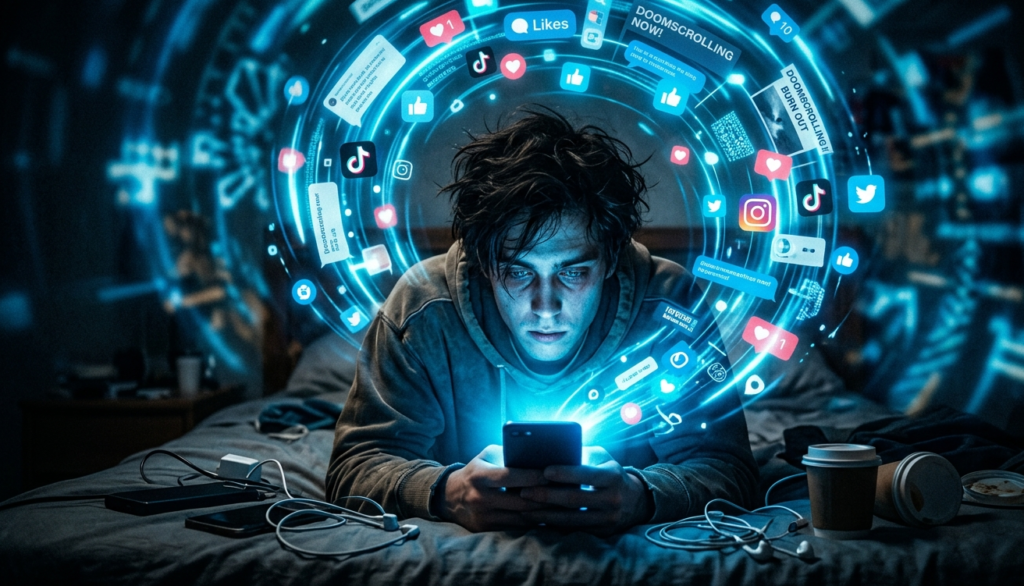
Have you ever opened an app just to check a quick notification, only to look up two hours later wondering where the time went? Your neck is stiff, your eyes are burning, and you feel a strange mix of exhaustion and agitation.
If this sounds familiar, you aren’t alone. In our hyper-connected world, a massive portion of the population has become “chronically online.” While the internet keeps us connected, informed, and entertained, spending too much time in digital spaces comes with a steep price. Behind the glass of your smartphone or laptop lies a finely tuned ecosystem designed to capture your attention—often at the direct expense of your neurological health, emotional stability, and overall well-being.
Here is a deep, science-backed look at exactly what excessive scrolling is doing to your brain, your mood, and your mental health, and how you can reclaim your peace of mind.
What Does It Mean to Be “Chronically Online”?
The phrase “chronically online” started as internet slang, but it has quickly evolved into a recognized psychological phenomenon. It describes someone who spends so much time on social media and internet forums that their perception of reality becomes warped by online culture, discourse, and hyper-exaggerated trends.
When you are chronically online, the boundary between the physical world and the digital world blurs. You begin to view real-world interactions through the lens of algorithms, comment sections, and viral videos.
But the impact isn’t just social or philosophical. It is deeply physiological.
1. The Neurological Shift: How the Internet Alters Brain Chemistry
Your brain is incredibly adaptable—a trait known as neuroplasticity. It alters its structure and pathways based on your daily habits and environment. When you spend hours everyday consuming short-form, rapid-fire digital content, you are literally rewiring your brain.
The Dopamine Slot Machine
Every time you scroll past a video, receive a “like,” or pull down to refresh a feed, your brain releases a micro-dose of dopamine, the neurotransmitter responsible for pleasure and reward.
Social media algorithms are built on a psychological principle called variable reward schedules—the exact same mechanism that makes slot machines addictive. Because you don’t know if the next scroll will bring a hilarious meme, a shocking news headline, or a boring advertisement, your brain keeps demanding “one more spin.”
Over time, this constant flooding of artificial dopamine desensitizes your reward pathways. Standard, real-world activities—like reading a book, going for a walk, or having a conversation—start to feel incredibly boring because they cannot compete with the high-octane stimulation of the screen.
Shrinking Attention Spans and Brain Gray Matter
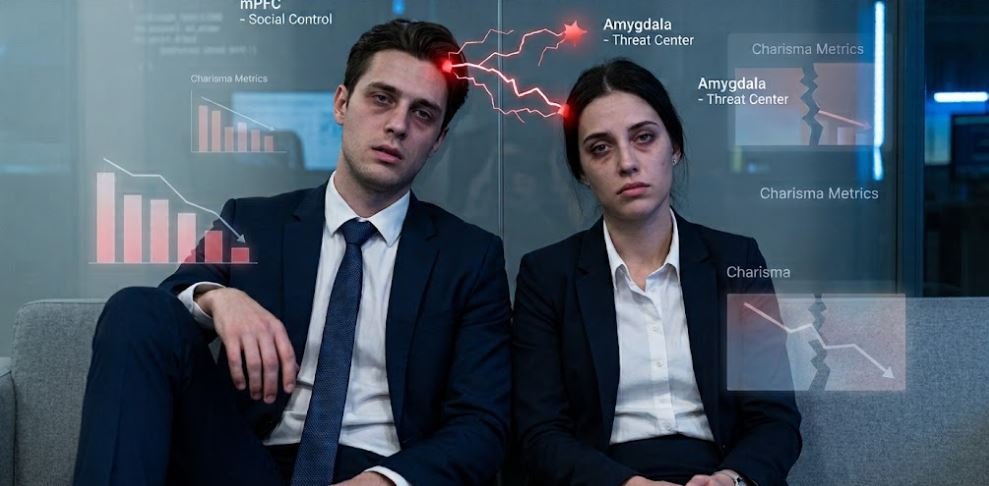
Neuroscientists have found that heavy internet multitasking and prolonged scrolling can impair the brain’s prefrontal cortex—the area responsible for:
- Focus and deep concentration
- Decision-making and impulse control
- Emotional regulation
When you train your brain to digest information in 15-second intervals, your capacity for sustained attention plummets. Studies utilizing MRI scans have even shown that individuals with severe internet and smartphone overuse exhibit a reduction in gray matter volume in regions associated with emotional processing and cognitive control.
2. The Melatonin Meltdown: How Blue Light Ruins Sleep and Mental Health
One of the most direct, physically destructive consequences of being online too long happens right before you go to sleep.
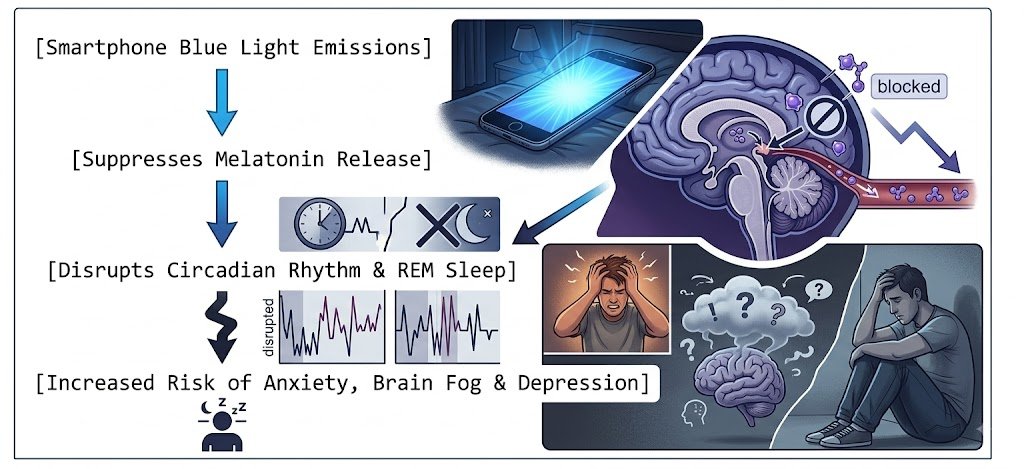
Your body operates on a natural 24-hour internal clock known as the circadian rhythm. This rhythm tells you when to wake up and when to sleep, primarily by responding to light cues in your environment. For millennia, the absence of sunlight signaled the brain to produce melatonin, the hormone that induces deep, restorative sleep.
Enter the modern smartphone.
The Biological Sabotage of Blue Light
The screens of our phones, tablets, and computers emit high concentrations of short-wavelength blue light. While blue light from the sun is beneficial during the day because it boosts alertness, artificial blue light at night acts as a biological saboteur.
When you lie in bed scrolling through social media, that blue light hits the photoreceptors in your eyes, sending a false message to your brain’s suprachiasmatic nucleus: “It is daylight outside. Do not sleep.”
As a result:
- Melatonin production is severely delayed or suppressed.
- Your sleep onset is pushed back, leading to late-night insomnia.
- The quality of your REM (Rapid Eye Movement) sleep—the crucial stage where your brain processes emotions and clears out metabolic waste—is heavily compromised.
The Link Between Bad Sleep and Mental Health Disorders
Sleep deprivation is not just about feeling tired the next day; it is a primary catalyst for mental health struggles. Chronic lack of quality sleep compromises your ability to handle stress, spikes your baseline cortisol (stress hormone) levels, and significantly increases your vulnerability to clinical depression and generalized anxiety disorders.
3. The Mood Rollercoaster: Emotional Consequences of Over-Scrolling
Being online too long doesn’t just change how your brain functions; it fundamentally alters how you feel on a day-to-day basis.
The Trap of “Doomscrolling”
Doomscrolling refers to the obsessive tendency to scroll through social media and news feeds filled with negative, terrifying, or depressing information.
Human beings are evolutionarily wired with a negativity bias—we pay closer attention to threats because it kept our ancestors alive. Algorithms know this. They deliberately prioritize content that provokes outrage, fear, or sadness because it keeps you glued to the screen longer.
When you spend hours absorbing global catastrophes, political arguments, and local tragedies, your nervous system is thrown into a prolonged state of fight-or-flight. Your body produces excess adrenaline and cortisol, leaving you feeling perpetually anxious, helpless, and hyper-vigilant.
The Comparison Trap and Hyper-Unrealistic Standards
Before the internet, you compared your lifestyle, appearance, and achievements to your neighbors or coworkers. Today, you compare yourself to a highly curated, heavily filtered highlight reel of the top 0.1% of the global population.
Even if you consciously know that a creator’s video is staged, edited, and enhanced by filters, your subconscious mind processes it as reality. Continuous exposure to this content fosters:
- Severe body image issues and dysmorphia
- Feelings of profound inadequacy and low self-esteem
- FOMO (Fear Of Missing Out), which leaves you feeling like everyone else is living a more exciting, meaningful life than you are.
4. The Loneliness Paradox: Connected via Fiber-Optics, Disconnected at the Heart
The profound irony of the digital age is that we are more interconnected than ever before, yet we are living through a global epidemic of loneliness.
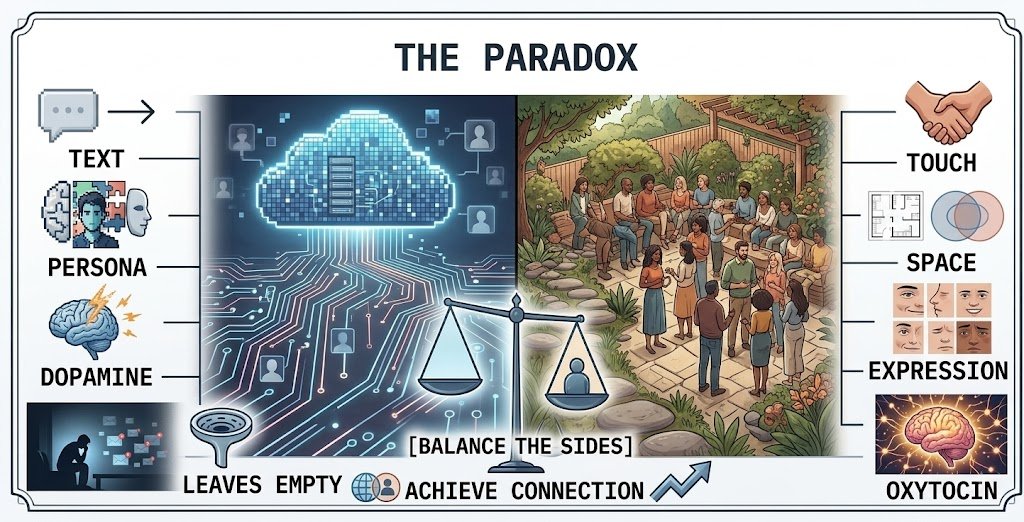
Digital interactions are inherently shallow. A comment, a DM, or a double-tap cannot replicate the complex, healing nature of real-life human contact. When we spend our time socializing online, we miss out on micro-expressions, physical touch, eye contact, and shared presence.
When you substitute physical community with online spaces, you starve your nervous system of oxytocin—the hormone responsible for bonding, trust, and feelings of safety. This digital isolation slowly erodes social skills, making real-world interactions feel increasingly awkward and anxiety-inducing, trapping users in a vicious cycle of further digital retreat.
Warning Signs: Are You Chronically Online?
How do you know if your internet use has crossed the line from a harmless pastime into a mental health hazard? Check if you experience these common warning signs:
- The Phantom Vibe: You constantly feel your phone vibrating in your pocket or next to you, even when it hasn’t received a notification.
- Immediate Escalation: The absolute first thing you do within 30 seconds of waking up, and the last thing you do before closing your eyes, is check your phone.
- Inability to Sit in Silence: You cannot wash the dishes, drive, eat a meal, or walk to the bathroom without a video playing or a feed to scroll through.
- Aggression and Low Patience: You find yourself easily annoyed by real-world tasks or slow conversations because they lack the rapid pace of internet content.
- Internet Arguments Matter: You feel genuine physical anger, a racing heart, or ruined moods over arguments happening between strangers in a comment section.
Practical Steps to Log Off and Reclaim Your Mental Health
You do not need to delete all your accounts and move into a cabin in the woods to fix this. In a modern economy, total disconnection is rarely practical. Instead, the goal is digital intentionality—taking back control of how and when you use technology.
1. Establish a Digital Curfew (Protect Your Melatonin)
To fix the damage done to your sleep cycles, create a non-negotiable rule: no screens 60 minutes before bed.
- Move your phone charger completely across the room or into another room entirely so you cannot reach it from bed.
- Swap your late-night scroll for a physical book, a journaling practice, or a meditation session.
- If you must look at a screen for work late at night, utilize blue-light-blocking glasses or activate your device’s built-in “Night Shift” mode to minimize melatonin suppression.
2. Implement the “Grey Scale” Trick
Our brains are highly attracted to bright, vibrant colors. Most social media apps use specific palettes of red, bright blue, and yellow to stimulate your eyes and keep you engaged.
- Go into your phone’s accessibility settings and change your display settings to Grayscale.
- When your Instagram, TikTok, or news feed is stripped of color and rendered in dull shades of gray, it instantly loses its addictive pull. Your screen time will naturally plummet.
3. Build Safe-Zone Boundaries
Create physical spaces and times throughout your day where screens are strictly forbidden.
- No Phones at the Dinner Table: Whether eating alone or with family, focus entirely on the sensory experience of your food and real conversation.
- The First 30 Minutes: Dedicate the first half-hour of your morning to hydration, stretching, and mental grounding before letting the noise of the global internet into your brain.
- Tech-Free Walks: Go for a 15-minute walk outside without headphones or a phone. Allow your mind to wander, daydream, and process background thoughts.
4. Audit Your Feed Regularly
Be ruthless about who and what you follow. If an account consistently leaves you feeling inadequate, anxious, angry, or envious, hit the unfollow or mute button. Actively seek out digital spaces that educate, inspire, or bring genuine joy, rather than those that feed on outrage.
Conclusion: Reality is Happening Offline
The internet is an incredible tool for learning and connecting, but it makes for a terrible home. Your brain was designed to interact with a physical environment—to see natural sunlight, to feel the rhythm of a slow day, and to connect deeply with the people right in front of you.
If you recognize that you’ve become chronically online, remember that your brain is resilient. By implementing boundaries, turning off the blue light before bed, and stepping away from the endless loop of the algorithm, you can break the dopamine addiction, heal your sleep cycles, and rediscover the calm, focused mental clarity that belongs to you.
Your life is happening right here, right now—not behind the glass.
Leave a Reply