

In a hyper-connected world that values the non-stop hustle, sacrificing sleep is frequently worn like a badge of honor. Many professionals boast about running on four or five hours of sleep, relying on strong coffee and sheer willpower to power through their jam-packed calendars. However, the human brain operates on biological mandates, not personal ambition.
When you shortchange your rest, your mental clarity pays the immediate toll. Occasional grogginess might seem manageable, but the invisible compound interest of chronic sleep debt erodes your focus, decision-making velocity, and cognitive longevity.
How much sleep do you actually need to protect your mind, optimize daily productivity, and avoid long-term cognitive decline? The short answer for most adults is a steady seven to nine hours per night. But to truly understand how to maintain peak executive performance, we must dig deeper into what happens behind closed eyes.
The Neurological Blueprint: How Sleep Refreshes Your Brain
To understand mental sharpness, we have to look closely at what your brain does while you sleep. Far from turning off, the brain shifts into a highly coordinated maintenance mode.
[ Wakefulness: Active Learning ] ──> [ Deep Sleep: Glymphatic Waste Clearance ] ──> [ REM Sleep: Memory Consolidation ]
During wakefulness, your brain’s high metabolic activity creates molecular waste products. The most notable of these is beta-amyloid, a toxic protein fragment associated with Alzheimer’s disease. When you drop into deep sleep, your brain activates its unique waste disposal system known as the glymphatic system.
During this restorative window, cerebrospinal fluid flows rapidly through the brain tissue, sweeping away metabolic debris accumulated throughout the day. If you cut your sleep short, you leave that biological clutter behind, leading to the sluggish “brain fog” that slows your processing speed the following morning.
Simultaneously, sleep is essential for memory consolidation—the process of converting short-term memories from the hippocampus into stable, long-term storage in the neocortex. While you sleep, your brain replays neural patterns from earlier in the day, reinforcing critical learning pathways while pruning away irrelevant noise. This ensures you wake up with both the storage capacity and mental flexibility required to solve complex problems and master new skills.
How Many Hours Do You Actually Need? (By the Numbers)
While individual sleep requirements fluctuate slightly based on genetics, lifestyle, and overall wellness, sleep needs fall across distinct biological ranges across our lifespans. The National Sleep Foundation (NSF) conducted a landmark multi-year analysis of scientific literature to map out definitive, evidence-based targets.
| Life Stage | Age Range | Recommended Daily Sleep Duration |
| Infants | 4 to 12 months | 12 to 16 hours (including naps) |
| Toddlers | 1 to 2 years | 11 to 14 hours (including naps) |
| Preschoolers | 3 to 5 years | 10 to 13 hours (including naps) |
| School-Age Children | 6 to 12 years | 9 to 12 hours |
| Teenagers | 13 to 18 years | 8 to 10 hours |
| Adults | 18 to 64 years | 7 to 9 hours |
| Older Adults | 65 years and older | 7 to 8 hours |
As shown above, adult minds require a baseline of seven to nine hours of sleep to avoid severe cognitive friction. A common misconception among seniors is that they naturally require significantly less sleep as they age. In reality, older adults need a similar amount of restorative rest as younger adults; however, changes in sleep architecture make their nighttime sleep more fragmented, which often necessitates daytime napping to hit their biological targets.
The Danger of Cumulative Sleep Debt
A common pitfall is the belief that you can “catch up” on lost sleep over the weekend. Sleep scientists refer to accumulated rest deficits as sleep debt. If you need eight hours of sleep but only log six hours from Monday through Friday, you finish the workweek with a massive 10-hour sleep deficit.
Sleeping in on Saturday and Sunday may ease immediate feelings of sleepiness, but studies demonstrate it does not fully restore baseline cognitive performance or reverse architectural disruptions to your circadian rhythm (your body’s internal clock).
Furthermore, research indicates that humans are notoriously poor judges of their own cognitive decline. When individuals are systematically restricted to six hours of sleep for two weeks, their performance on objective psychomotor vigilance tests plummets to a level equivalent to staying awake for 48 consecutive hours. Yet, when surveyed, these sleep-deprived individuals consistently report feeling “fine” or “only slightly tired.” You might believe you are functioning beautifully on minimal sleep, but objective metrics reveal your working memory, reaction speed, and emotional control are quietly suffering.
Quality vs. Quantity: Deconstructing the Sleep Cycle
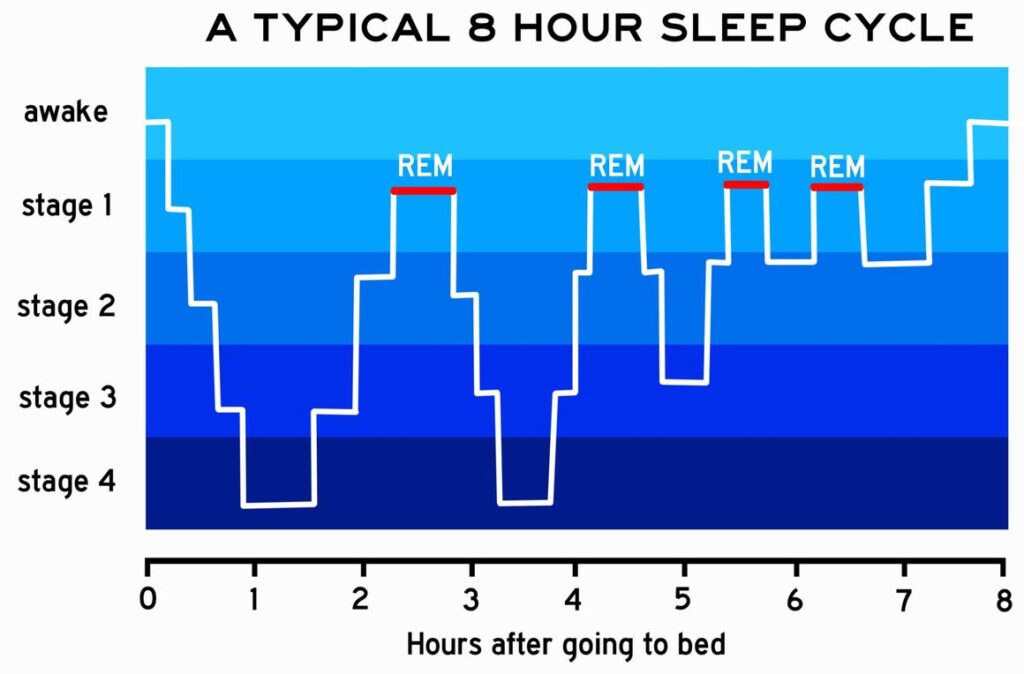
Securing eight hours in bed means very little if your sleep architecture is heavily disrupted. A healthy night of sleep is not a uniform block of unconsciousness. Instead, it is composed of four to six sequential cycles lasting roughly 90 to 120 minutes each.
As illustrated above, an optimal night moves fluidly through distinct stages:
- Stage 1 (Light NREM): The transitional phase between wakefulness and sleep. Your muscles relax, and your brain waves begin to slow.
- Stage 2 (Light NREM): Your body temperature drops, and heart rate slows. This stage accounts for roughly 50% of your total night and features brief bursts of brain activity called sleep spindles, which are crucial for memory integration.
- Stage 3 (Deep NREM): Also known as slow-wave sleep. This is the physically and mentally restorative phase where tissue repair occurs, growth hormones are released, and the glymphatic clearance process reaches its peak.
- REM (Rapid Eye Movement): The stage where dreaming occurs. Your brain activity mirrors wakefulness, and your eyes move rapidly. REM sleep is highly concentrated in the final third of the night and is critical for emotional processing, creative insight, and complex cognitive synthesis.
If your sleep is fragmented by noise, alcohol, or stress, your brain resets its cycles constantly, shortchanging you on vital deep and REM sleep windows. This explains why you can spend nine hours in bed but still wake up feeling utterly depleted.
Concrete Signs Your Mind is Starved for Rest
How do you determine if your current routine is truly supporting your brain health? Watch closely for these clear warning signs:
- Elevated Decision Fatigue: You find yourself struggling with simple choices or feeling unusually overwhelmed by routine task prioritization.
- Micro-sleeps and Mind-Wandering: Catching yourself staring blankly at your monitor, reading the same paragraph three times, or experiencing brief, involuntary lapses in attention while driving.
- Irritability and Emotional Volatility: The prefrontal cortex—the area of the brain responsible for rational oversight—loses its regulatory control over the emotional amygdala when sleep-deprived, causing heightened reactivity to daily stressors.
- Heavy Reliance on Stimulants: Needing caffeine past 2:00 PM just to sustain standard productivity or prevent afternoon crashes.
Actionable Strategies to Optimize Cognitive Sharpness
To consistently achieve the restorative rest your brain requires to think quickly and stay focused, you must prioritize both your sleep environment and daily habits.
1.Establish a strict sleep anchor:Daily Consistency.
Wake up at the exact same time every morning, including on weekends. This anchors your circadian rhythm, making it easier to fall asleep naturally when night arrives.
2.Control your light exposure:Circadian Alignment.
Expose your eyes to bright, natural sunlight within 30 minutes of waking to stop melatonin production. Conversely, eliminate blue-light emitting screens (phones, tablets, televisions) at least 60 minutes before bed to allow your brain to naturally secrete sleep-inducing hormones.
3.Optimize your thermal environment:Environment Design.
Set your bedroom thermostat between 60°F and 67°F (15°C to 19°C). Your body needs to lower its core temperature by about two degrees Fahrenheit to initiate and sustain deep sleep.
4.Enforce a chemical curfew:Dietary Boundaries.
Stop consuming caffeine at least 8 to 10 hours before your target bedtime, as its quarter-life can disrupt sleep architecture long after its noticeable effects fade. Avoid alcohol within 3 to 4 hours of sleeping; while it acts as a sedative, it violently fragments sleep cycles and can eliminate REM sleep windows entirely.
The Ultimate Executive Leverage Tool
Viewing sleep as a luxury you cannot afford is a massive cognitive error. True mental sharpness, creative vision, and emotional balance are built directly on a foundation of high-quality, uninterrupted rest. When you optimize your nightly recovery, you directly boost your focus, processing speed, and emotional control during the day.
If you are eager to build sustainable evening routines, optimize your biological clock, and implement evidence-backed wellness habits, exploring high-quality sleep health strategies is an excellent next step to unlocking your full potential. Protect your sleep boundaries with the same discipline you apply to your professional commitments. Your brain will thank you with sharper insights, clearer focus, and sustained vitality for years to come.
References and Citations
- Suni, E., & Singh, A. (2022). How Much Sleep Adults Need. Sleep Foundation. https://www.sleepfoundation.org/how-sleep-works/how-much-sleep-do-we-really-need
- National Sleep Foundation. Landmark Sleep Duration Guidelines. The NSF Organization. https://www.thensf.org/recommended-amount-of-sleep/
- Hirshkowitz, M., et al. (2015). National Sleep Foundation’s sleep time duration recommendations: methodology and results summary. Sleep Health: Journal of the National Sleep Foundation, 1(1), 40-43. https://pubmed.ncbi.nlm.nih.gov/29073398/
- National Institute of Child Health and Human Development (NICHD). How much sleep do I need? U.S. Department of Health and Human Services. https://www.nichd.nih.gov/health/topics/sleep/conditioninfo/how-much
- American Academy of Sleep Medicine & Sleep Research Society (2015). Recommended amount of sleep for a healthy adult: a joint consensus statement. Sleep, 38(6), 843–844.



Leave a Reply