

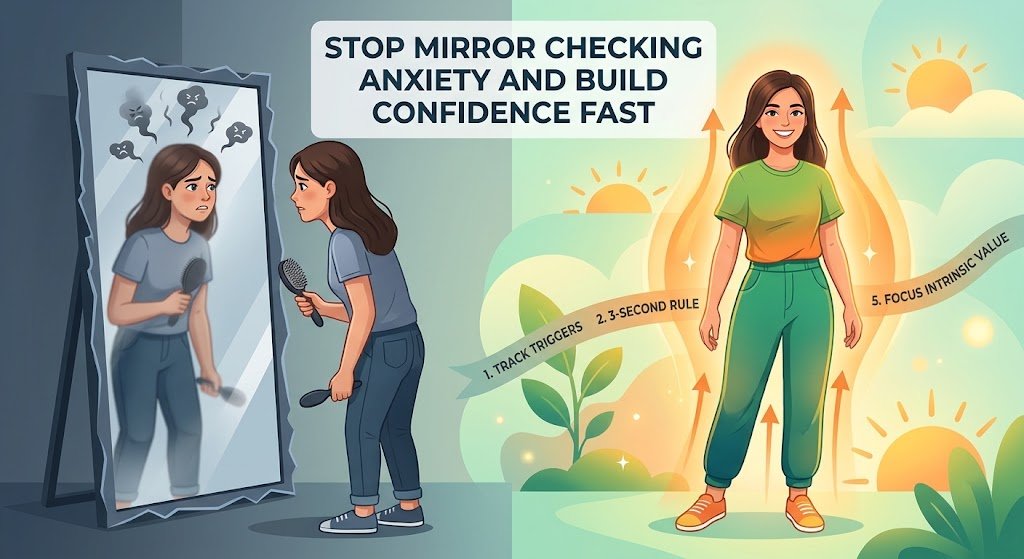
Have you ever caught yourself staring into a mirror, scrutinizing every single pore, line, or perceived flaw on your face, only to walk away feeling significantly worse than before? You are not alone. For millions of people, a quick check in the glass quickly turns into a repetitive, anxiety-fueling ritual. What starts as a simple desire to look good quickly spirals into a cycle of self-doubt and heightened stress.
This guide reveals how to break free from compulsive reflection habits, reclaim your time, and build confidence from the inside out.
The Hidden Trap of Constant Reflection
Checking your appearance seems harmless, but doing it dozens of times a day actually rewires your brain to spot defects rather than overall balance. Psychologists refer to this behavior as a safety habit—an attempt to soothe underlying anxiety about how others perceive you.
When you stare closely at your reflection, your visual system experiences habituation. The longer you look at a specific feature, the more unusual or distorted it appears. Instead of reassuring you, each glance confirms your worst insecurities, creating a loop that demands even more checking.
5 Steps to Break the Habit and Feel Secure
1. Track Your Triggers
Before you can stop a behavior, you need to spot when it happens. Keep a quick mental tally or note on your phone every time you reach for a mirror, a reflective window, or your phone’s front-facing camera. Notice the emotion driving the urge—is it boredom, stress before a social event, or a sudden surge of self-consciousness?
2. Implement the 3-Second Rule
Set a strict, non-negotiable rule for necessary mirror use, such as styling your hair or brushing your teeth:
- Give yourself three seconds to complete the grooming task.
- Step back at least two feet to maintain a realistic, natural perspective.
- Immediately turn away once the task is finished.
3. Cover Up Problem Mirrors
Remove the temptation entirely while your brain resets:
- Place sticky notes or small decorative towels over mirrors you frequently pass in hallways or bedrooms.
- Put hand mirrors away in drawers rather than leaving them on desks or vanity counters.
- Avoid using your smartphone screen as a dark reflective surface during idle moments.
4. Practice Delaying the Urge
When you feel a strong craving to check your appearance, use impulse surfing. Acknowledge the urge without acting on it immediately. Wait just two minutes. During those two minutes, take three slow breaths or focus intensely on an object across the room. Often, the spike of anxiety peaks and passes without requiring you to look in the glass.
5. Shift to Intrinsic Value
Rebuild your self-worth by focusing on what your body does rather than exclusively how it looks:
- Celebrate physical strength, endurance, and sensory experiences.
- Reframe internal self-talk from “How do I look right now?” to “How do I feel right now?”
- Engage in active hobbies like running, painting, or cooking that pull your attention outward into the physical world.
Why Reducing Mirror Time Restores Your Brain
When you stop constantly checking your reflection, your brain gradually learns that your physical appearance does not require continuous monitoring to stay safe or accepted. Over time, your baseline anxiety drops dramatically, freeing up mental energy for meaningful goals, relationships, and personal growth.
If you ever experience a sudden breakdown in your household infrastructure, taking immediate action prevents total chaos. Just as fixing a burst pipe requires calling an emergency plumber to secure your home, addressing emotional habits protects your inner peace before deeper psychological stress takes hold.
By stepping away from the glass, you trade temporary aesthetic reassurance for a proven way to build confidence that lasts.
Scientific References
| # | Author(s) & Year | Article / Study Title | Journal / Source | Key Finding |
| 1 | Veale, D., & Riley, S. (2001) | Mirror gazing in body dysmorphic disorder | Behaviour Research and Therapy | Prolonged mirror gazing increases selective attention to perceived flaws and elevates anxiety levels. |
| 2 | Windheim, G., et al. (2011) | To look or not to look: The effects of mirror gazing | Journal of Behavior Therapy | Reducing repetitive mirror checks significantly decreases appearance-related distress over time. |
| 3 | Baldock, E., et al. (2012) | Visual processing during mirror gazing | Body Image Journal | Extended visual focus on specific facial features causes perceptual distortion in healthy individuals. |
| 4 | Wilhelm, S., et al. (2013) | Cognitive-behavioral therapy for appearance anxiety | American Psychological Association | Exposure and response prevention techniques successfully reduce compulsive grooming behaviors. |
| 5 | Cash, T. F. (2008) | The Body Image Workbook | New Harbinger Publications | Shifting focus from external evaluation to internal body function improves overall self-esteem. |


Leave a Reply