

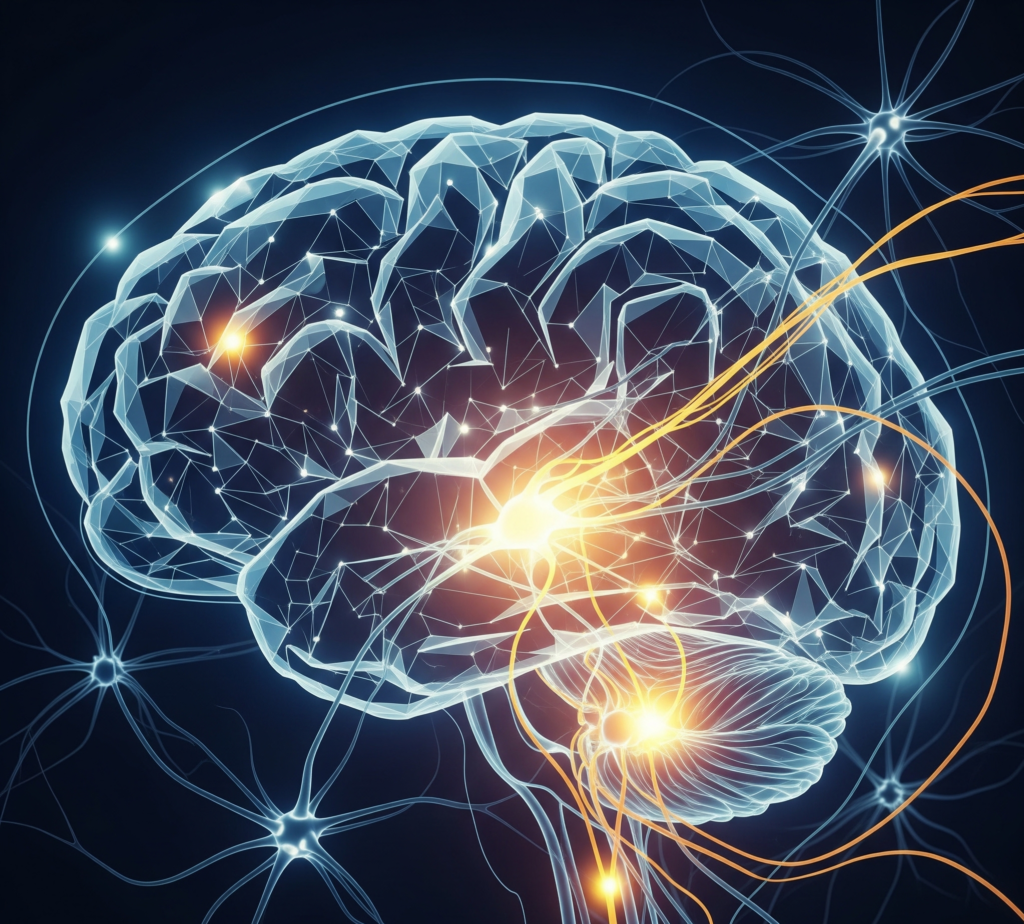
We are, in many ways, the sum of our habits. From the specific sequence in which you brush your teeth to the way you react when a deadline looms, our daily lives are governed by deep-seated neural pathways. But have you ever wondered why some habits—like checking your phone the moment you wake up—are incredibly easy to form, while others—like a consistent meditation practice—feel like an uphill battle?
The answer lies in the incredible plasticity of your brain. Understanding the neuroscience behind habit formation is not just an academic exercise; it is the key to unlocking true personal change. You aren’t just “stuck” with your current behaviors. Your brain is a dynamic organ designed to learn, adapt, and—crucially—rewire itself.
1. The Anatomy of a Habit: Basal Ganglia vs. Prefrontal Cortex
To understand how to change your brain, you must first understand the internal power struggle between two specific regions: the Prefrontal Cortex (PFC) and the Basal Ganglia.
The Executive: The Prefrontal Cortex
The PFC is the newest part of the human brain, located right behind your forehead. It is responsible for complex decision-making, planning, and logical thought. When you decide, “I am going to start eating more vegetables,” that is your PFC talking. However, the PFC is “expensive” to run. It requires a massive amount of glucose and mental energy. It tires easily, which is why your willpower often evaporates by 6:00 PM.
The Auto-Pilot: The Basal Ganglia
Deep in the center of the brain lies the Basal Ganglia. This cluster of neurons is responsible for motor control and “chunking” behaviors into automatic routines. When a behavior becomes a habit, the brain pushes the “program” for that behavior from the PFC down into the Basal Ganglia.
This is an evolutionary survival mechanism. If your brain had to consciously think about how to walk, breathe, and drive a car all at once, you would be paralyzed by choice. By automating these “low-level” tasks, the brain conserves energy for high-level survival threats. The problem? The Basal Ganglia doesn’t distinguish between “good” habits (exercise) and “bad” habits (smoking). It simply executes the most reinforced program.
2. The Science of the “Habit Loop”
Behavioral psychologists and neuroscientists generally agree that every habit consists of three core components, often called the Habit Loop:
- The Cue (The Trigger): This is the spark. It can be a time of day, a location, an emotional state (boredom, stress), or a specific preceding action.
- The Routine (The Behavior): This is the action you perform in response to the cue. It is the part we usually focus on when we want to “change.”
- The Reward (The Reinforcement): This is the positive reinforcement that tells your brain, “That was useful; let’s do it again.”
The Craving Component: Over time, a fourth element develops: Craving. As the loop repeats, your brain begins to anticipate the reward the moment it perceives the cue. This is why just smelling coffee (the cue) can make you feel more awake before you’ve even taken a sip. Your brain has already begun the chemical process of the routine.
3. Dopamine: The Great Motivator
Dopamine is the primary neurotransmitter involved in habit formation. Contrary to popular belief, dopamine isn’t just about the “high” of pleasure. It is the molecule of anticipation and learning.
When you experience a reward for the first time, your brain releases a spike of dopamine after the event. However, as the habit forms, the dopamine spike moves. Eventually, the dopamine hits as soon as you see the cue.
This is what creates the “urge.” If you walk past a bakery and see a croissant, your brain releases dopamine in anticipation. If you don’t get the croissant, your dopamine levels plummet, leading to a feeling of frustration or “craving.” To rewire your brain, you must learn to navigate these dopamine dips.
4. Neuroplasticity: The Biological Foundation of Change
The most hopeful finding in modern neuroscience is neuroplasticity—the brain’s ability to reorganize itself by forming new neural connections throughout life.
Hebbian Theory: Neurons That Fire Together, Wire Together
When you perform a new action repeatedly, you are physically strengthening the synapses between neurons. Imagine a dense forest. The first time you walk through it, it’s difficult; you have to hack through vines and brush. The second time is slightly easier. By the hundredth time, you have a clear, paved path.
Myelination: The Insulation of Habit
As you repeat a behavior, your brain wraps the neural pathway in a fatty substance called myelin. This acts like insulation on an electrical wire, allowing signals to travel faster and with less energy. This is why old habits are so hard to break—they are literally high-speed, “insulated” highways in your brain, while new habits are just dirt paths.
5. Why Willpower Isn’t Enough
Many people fail at habit change because they rely solely on willpower. Neuroscience tells us that willpower is a finite resource. This is known as Ego Depletion.
Because the Prefrontal Cortex (willpower) and the Basal Ganglia (habit) are in competition, any time you are tired, hungry, or stressed, the PFC loses its grip. The brain defaults to the “cheapest” energetic option: the old habit stored in the Basal Ganglia. To successfully rewire your brain, you must stop fighting your biology and start designing systems that work with it.
6. Advanced Strategies for Conscious Rewiring
If your brain is constantly being shaped by your environment, you can take the driver’s seat by using these science-backed strategies:
Habit Stacking
The brain’s most efficient way to learn a new behavior is to attach it to an existing neural pathway. This is called Habit Stacking.
- Formula: “After [Current Habit], I will [New Habit].”
- Example: “After I pour my morning coffee (strong pathway), I will write down my three most important tasks for the day (new pathway).”
Environmental Design: Reducing Friction
Your brain is a reactive organ. It follows the path of least resistance.
- To create a good habit: Reduce the “friction.” If you want to run in the morning, lay your clothes out the night before.
- To break a bad habit: Increase the friction. If you want to stop scrolling on your phone, put it in a different room. By adding even five seconds of “thinking time,” you give your Prefrontal Cortex a chance to “wake up” and override the Basal Ganglia.
The Power of “Micro-Habits”
If a goal feels daunting, your amygdala (the brain’s fear center) might trigger a stress response, leading to procrastination. Make the habit so small it’s impossible to fail.
- Instead of “Exercise for 60 minutes,” try “Put on my running shoes.”
- Instead of “Write a book,” try “Write one sentence.” By lowering the threshold, you allow the neural pathway to begin forming without the resistance of the “fear brain.”
7. The Timeline of Rewiring: How Long Does It Really Take?
You may have heard that it takes 21 days to form a habit. Neuroscience suggests this is a myth. A study from University College London found that, on average, it takes 66 days for a new behavior to become automatic.
However, the timeline varies depending on:
- Complexity: Drinking a glass of water is easier to automate than doing 50 pushups.
- Consistency: Missing one day won’t ruin your progress, but the more “reps” you get in, the faster the myelination occurs.
- Reward Strength: The more immediate and satisfying the reward, the faster the dopamine system locks the habit in.
8. How to Effectively “Delete” a Bad Habit
Technically, you don’t “delete” a habit; you override it. The old neural pathway for a bad habit remains in your brain (like an old trail in the woods), but it can become overgrown and weak if it is no longer used.
To override a habit:
- Identify the Reward: Are you smoking because you need nicotine, or because you need a 5-minute break from work?
- Keep the Cue and Reward, Change the Routine: If the reward is a “break,” try walking around the block instead of smoking. You are satisfying the same brain requirement (the reward) using a different neural path.
- The “If-Then” Plan: Create an implementation intention. “If I feel the urge to snack while watching TV, then I will drink a glass of sparkling water.” This pre-decides the action, saving your PFC from having to make a choice in a moment of weakness.
9. Conclusion: You Are the Architect
The neuroscience of habit formation is a testament to human resilience. It proves that we are not fixed entities; we are works in progress. Every time you choose a new behavior, you are physically changing the structure of your brain.
Rewiring your brain is not about a sudden burst of inspiration; it is about the quiet, consistent repetition of small actions. It is about understanding that your brain wants to help you, but it needs the right instructions.
Start small, be patient with your biology, and remember: every time you repeat a positive action, you are laying another layer of myelin on the path to a better you.
Leave a Reply