

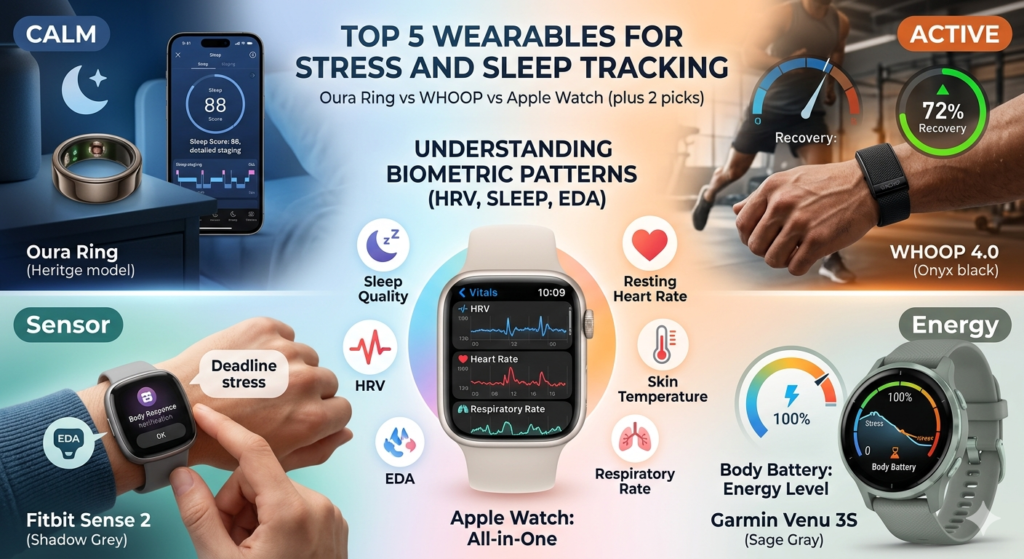
Oura Ring vs WHOOP vs Apple Watch (plus 2 picks)
Stress can feel invisible—until it shows up as poor sleep, a racing mind, and that “wired but tired” energy the next day. Wearables can’t diagnose anxiety or measure your emotional load, but they can give you a daily snapshot of how your body is coping by tracking signals like sleep quality, heart rate variability (HRV), resting heart rate, skin temperature, respiratory rate, and (in a few devices) electrodermal activity (EDA). Over time, those trends can help you spot patterns and build a calmer routine.
Quick takeaways: Most wearables do not measure cortisol directly. Instead, they estimate “stress” from nervous-system proxies like HRV and heart rate, and they connect the dots with sleep data. If your primary goal is sleep-first stress management, Oura Ring tends to be the most comfortable and consistent for overnight metrics; if you want a training + recovery coach, WHOOP is built around that; if you want an all-purpose smartwatch with strong health features, Apple Watch is the most versatile. For a stress-specific sensor, Fitbit Sense 2 stands out with continuous EDA (“body response”) tracking. And if you want a simple “energy gauge” that blends stress, sleep, and activity, Garmin devices with Body Battery are popular.
Can wearables track cortisol? Here’s the reality
In everyday conversation, people say they want a wearable that “tracks cortisol.” What they usually mean is: “I want to know when my body is stressed, and whether I’m recovering.” Today’s mainstream wearables (including Oura, WHOOP, Apple Watch, Garmin, and Fitbit) don’t provide a direct cortisol reading. Instead, they estimate physiological stress through biometrics that change when your autonomic nervous system shifts into a more activated state—especially HRV (often lower under strain), resting heart rate (often higher), and sleep disruption (more wake-ups, less deep sleep, later sleep onset). Some devices also incorporate skin temperature and respiratory rate, and Fitbit adds EDA, which measures small changes in skin conductance linked to arousal.
Mental health note: Wearable data is best used as a gentle feedback tool—not a verdict. If metrics start increasing your anxiety (for example, you feel worse after checking your sleep score), consider hiding scores and focusing on weekly trends, or taking breaks. And if you’re experiencing persistent distress, panic symptoms, or sleep issues that don’t improve, a licensed clinician can help you interpret what’s happening beyond what a device can measure.
What to look for in a stress-management wearable
- Sleep accuracy and consistency: stress management often starts with sleep. Look for clear sleep-stage reporting and stable night-to-night capture.
- HRV captured during sleep: overnight HRV tends to be less “noisy” than daytime spot checks.
- Comfort for 24/7 wear: the best device is the one you can tolerate overnight.
- Battery life (and charging habits): if you have to charge daily, you may miss nights.
- Stress features you’ll actually use: real-time stress prompts, breathing tools, or weekly resilience coaching.
- Cost over time: many platforms lock advanced insights behind subscriptions.
- Data ecosystem: consider how easily your device shares with your phone’s health app and any therapy, journaling, or mindfulness tools you already use.
At-a-glance comparison (stress + sleep)
| Wearable | Best for | Stress signals used | Sleep strengths | Main tradeoff |
| Oura Ring | Sleep-first recovery + daily stress awareness | HRV, heart rate, temperature, motion; stress features in-app | Comfortable overnight wear; detailed sleep staging and trends | Membership required for deeper insights |
| WHOOP | Training load, recovery coaching, habit experiments | HRV, resting HR, respiratory rate, sleep performance; stress metric | Strong sleep coaching tied to recovery/strain | Subscription-only model; not a smartwatch |
| Apple Watch | All-in-one smartwatch + health tracking | HRV (spot/overnight), heart rate, respiratory rate; mindfulness tools | Sleep stages + “Vitals” overview on newer watchOS | Battery can make consistent sleep tracking harder |
| Fitbit Sense 2 | Stress-specific tracking and prompts | Continuous EDA (body response), HR/HRV, sleep; stress score | Strong sleep dashboards and long battery life | Some advanced insights require Premium |
| Garmin (Body Battery models) | Energy management + stress/activity balance | HRV, heart rate, movement; stress score + Body Battery | Good sleep + recovery context for active users | UI/metrics can feel training-oriented vs mental-health oriented |
1) Oura Ring: best for sleep-first stress awareness
If your stress shows up most clearly as sleep problems—trouble falling asleep, waking up at 3 a.m., or feeling unrested—Oura is often the easiest wearable to stick with. Because it’s a ring, many people find it less disruptive at night than a watch. Oura’s stress approach is built around the idea that your body’s “load” shows up as shifts in HRV, heart rate, temperature, and sleep continuity. In practice, this makes it a strong option for people who want to connect daytime stress patterns with overnight recovery.
What it’s measuring (your cortisol “proxies”): Oura uses HRV and heart rate data plus temperature and motion to estimate when your body is in a more stressed vs restorative state, and it summarizes recovery with sleep and readiness-style insights. Oura also describes its stress approach as combining multiple biometrics to help you see patterns over time rather than relying on a single moment.
- Pros: very comfortable for sleep; excellent sleep-first insights; useful long-term trend views for recovery and stress patterns.
- Cons: not a full smartwatch; advanced insights typically require a membership; if you want real-time workout metrics like GPS, you may prefer a watch.
- Best way to use it for stress management: pick one weekly reflection question (e.g., “What made me feel calm this week?”) and compare it to your weekly sleep consistency and HRV trend—then adjust one habit at a time (bedtime, caffeine cutoff, evening screen routine, or wind-down practice).
2) WHOOP: best for recovery coaching and stress load
WHOOP is built around one central question: “How much strain did I accumulate, and am I recovered enough to handle more?” That framing can be helpful for stress management because it treats mental stress, poor sleep, travel, and intense workouts as part of the same load-and-recovery system. WHOOP tracks your body 24/7 and summarizes your day with sleep, strain, and recovery insights, plus a real-time stress metric on some tiers.
What it’s measuring (your cortisol “proxies”): WHOOP’s core approach combines HRV, resting heart rate, respiratory rate, and sleep performance into daily coaching signals (like recovery), and it frames strain as the body’s accumulated load across the day. WHOOP positions itself as 24/7 monitoring across sleep, strain, stress, and heart health with personalized coaching.
- Pros: excellent for people who like structured feedback; ties sleep needs to strain; encourages recovery behaviors when metrics trend down.
- Cons: subscription-only; no traditional smartwatch screen; coaching can feel performance-oriented if your goal is gentle mental wellness.
- Best way to use it for stress management: treat “strain” as a boundary-setting tool. If your recovery is consistently low, experiment with one supportive change (earlier bedtime, lighter workouts, or a true rest day) and see how HRV trends over 1–2 weeks—rather than reacting to one bad day.
3) Apple Watch: best all-in-one health + life wearable
Apple Watch is the “Swiss Army knife” option: it can support stress management, but it’s not solely a recovery tracker. If you want notifications, calls, safety features, workouts, and health data in one place, it’s hard to beat. For stress and sleep, the Apple ecosystem shines when you want to combine multiple signals—sleep stages, overnight heart rate, respiratory rate, and HRV—then pair them with mindfulness, journaling, or therapy homework in apps you already use.
What it’s measuring (your cortisol “proxies”): Apple Watch captures HRV and other overnight health metrics during sleep. With watchOS 11, Apple introduced a Vitals app that surfaces sleep-related metrics like heart rate, respiratory rate, wrist temperature, sleep duration, and blood oxygen, and flags when multiple metrics are outside your typical range.
- Pros: best overall smartwatch; strong health feature set; integrates with many mental health, sleep, and mindfulness apps.
- Cons: battery life can make overnight tracking inconsistent unless you build a charging routine; HRV is often collected as intermittent readings rather than a single clean “overnight HRV” score.
- Best way to use it for stress management: set a simple nightly loop: enable Sleep Focus, wear the watch to bed, then check only one morning metric (sleep duration or Vitals out-of-range) and one weekly metric (HRV trend). Keep the goal small: “notice patterns,” not “optimize perfectly.”
4) Fitbit Sense 2: best for stress-specific sensing (EDA)
If you want a wearable that explicitly focuses on stress events—not just recovery after the fact—Fitbit Sense 2 is a compelling option. Its differentiator is continuous electrodermal activity (EDA) sensing, which Fitbit uses to detect “body response” events (physiological arousal) and prompt reflection. For many people, that prompt is the bridge between body signals and emotional awareness: “What just happened?” “Was I rushing, avoiding, over-caffeinated, or overstimulated?”
What it’s measuring (your cortisol “proxies”): Fitbit’s stress approach blends sleep, heart-related signals, and activity into a Stress Management Score, and on Sense 2 it uses a continuous EDA sensor to identify “body responses” and optionally notify you so you can reflect on your emotions.
- Pros: stress-focused features; continuous EDA-based arousal detection; typically strong battery life for sleep tracking.
- Cons: some advanced insights may require a subscription; “body response” is not the same as psychological stress (exercise, excitement, temperature, and caffeine can also trigger arousal).
- Best way to use it for stress management: keep reflections simple. When you get a prompt, log one neutral label (e.g., “deadline,” “commute,” “conflict,” “caffeine,” “scrolling,” “workout”) and look for repeats over a week. Then choose one repeat trigger to soften with a small change.
5) Garmin: best for “energy” tracking (Body Battery)
Garmin is often chosen by runners, cyclists, and outdoorsy folks—but its stress features can also be useful for everyday mental wellness, especially if you like a simple, legible number that answers: “How much capacity do I have today?” Garmin’s Body Battery is essentially an energy estimate that rises with rest/sleep and drops with stress and activity, giving you a way to see when you’re draining faster than you’re recovering.
What it’s measuring (your cortisol “proxies”): Garmin describes Body Battery as energy monitoring that makes the combined influences of physical activity, stress, rest, and sleep visible, using analysis of heart rate, HRV, and movement.
- Pros: clear “energy reserve” metaphor; good for balancing training + life stress; many models offer long battery life.
- Cons: can feel fitness-centric; stress scores may rise during non-stressful situations that elevate heart rate (heat, caffeine, illness).
- Best way to use it for stress management: plan your day like you’d use a phone battery. If you start the morning low, schedule fewer high-effort tasks, add short “recharge” breaks, and treat early bedtime as a recovery tool—not a failure.
How to choose the right stress wearable for you
Choose Oura Ring if… you want the most frictionless sleep tracking and you prefer calm, sleep-first insights over constant prompts.
Choose WHOOP if… you like coaching, you train regularly (or your lifestyle is physically demanding), and you want stress framed as “load + recovery.”
Choose Apple Watch if… you want a smartwatch first, but still want meaningful sleep and recovery signals (especially when combined with the broader Apple Health ecosystem).
Choose Fitbit Sense 2 if… you want stress detection to be explicit and reflective (EDA-based “body response” prompts), and you value longer battery life for consistent nights.
Choose Garmin if… you want an “energy meter” that blends stress, activity, and sleep—especially if you’re active and appreciate long battery life.
How to use wearable data without spiraling
For many people, numbers are soothing—until they’re not. If you’re using a wearable for stress management, the goal isn’t to chase perfect metrics; it’s to learn what helps you feel steadier and sleep better. These strategies keep the data supportive:
- Zoom out to trends: check weekly averages (sleep duration, sleep consistency, HRV trend) instead of daily scores.
- Pick one “north star” metric: for most people, that’s sleep duration or sleep regularity—because it’s the foundation for resilience.
- Use context tags: note alcohol, late meals, travel, illness, intense workouts, and high-conflict days. Stress proxies shift for many reasons.
- Create a “low-data mode”: hide readiness/recovery scores for 2 weeks and only track bedtime/wake time. Reintroduce metrics when curiosity feels calm again.
- Don’t self-diagnose from HRV: HRV varies widely by person. What matters is your personal baseline and direction over time.
- Let the wearable prompt support, not judgment: if the device flags stress, use it as a cue for one small regulation skill (2 minutes of slow breathing, a short walk, unclenching your jaw, or stepping away from a screen).
A simple 2-week reset experiment: Keep your wake time within the same 60-minute window, get outdoor light within an hour of waking, stop caffeine 8 hours before bed, and add a 10-minute wind-down routine (stretching, shower, reading, or breathwork). Then look at only three outcomes: (1) how you feel on waking, (2) sleep consistency, and (3) your HRV or recovery trend. If two of three improve, you’ve found a lever worth keeping.
FAQ: stress wearables, cortisol, and sleep tracking
Do any of these wearables measure cortisol directly?
No. These devices estimate physiological stress using proxies like HRV, heart rate, sleep disruption, temperature, respiratory rate, and (for Fitbit Sense 2) electrodermal activity. If you see “cortisol” used in marketing language, it’s usually referring to stress estimation—not a hormone measurement.
Which wearable is best for sleep tracking?
For many people, the best sleep tracker is the one you’ll wear consistently. Rings (like Oura) tend to be very comfortable at night, while watches can offer richer daytime features. If you often forget to charge a watch, prioritize devices with longer battery life so you don’t miss nights.
Is HRV a good indicator of stress?
HRV can be a useful signal of how taxed or recovered your nervous system is, but it’s not a direct “stress meter.” HRV shifts with sleep, illness, alcohol, training, hydration, menstrual cycle changes, and more. The most useful approach is tracking your personal baseline and week-to-week direction.
Which is best if I want stress prompts in the moment?
If prompts help you pause and self-regulate, Fitbit Sense 2’s EDA-based “body response” notifications can support that reflective moment. WHOOP and Oura also surface stress-related insights, but Fitbit is the most explicitly built around detecting arousal and asking you to check in.
Do I need a subscription for stress and sleep insights?
Often, yes—at least for deeper analysis. WHOOP is subscription-only. Oura typically requires a membership for full insights. Fitbit may reserve advanced dashboards for Fitbit Premium. Garmin generally offers most features without a subscription, and Apple Watch’s core health features are included, though many people add third-party apps for more stress-focused interpretation.
What if wearables make me more anxious?
That’s common—and it’s a sign to simplify. Hide scores, turn off stress notifications, and focus on steady habits (regular wake time, evening wind-down, movement, connection). Wearables should support your wellbeing; if they increase rumination, it’s okay to use them less or not at all.
Bottom line
The best wearable for stress management is the one that helps you notice patterns and take kinder actions—earlier sleep, fewer late stimulants, more recovery, and more moments of downshift during the day. None of these devices truly “tracks cortisol,” but all of them can help you infer when your system is carrying more load than usual by combining sleep and nervous-system signals.
If you want the simplest path to better sleep awareness, start with Oura. If you want a recovery coach that treats life stress and training as one system, consider WHOOP. If you want one device that also runs your day, Apple Watch is the most versatile. For stress-event detection and reflection prompts, Fitbit Sense 2 is a strong pick. And for an energy-first view that pairs well with an active lifestyle, Garmin’s Body Battery models are a solid choice.
Reader question: Are you looking for fewer stress spikes during the day, better sleep at night, or both? If you share your main goal (and whether you prefer a ring, band, or smartwatch), I can help you narrow this down to the best fit.


Leave a Reply