

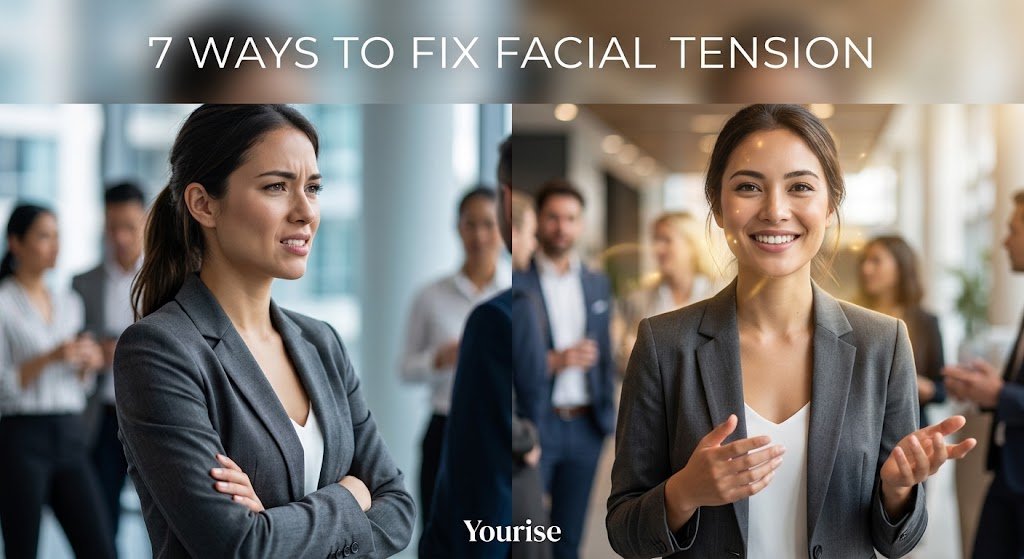
You spend hours curating your image, dressing sharply, and perfecting your skincare routine. Yet, despite your polished appearance, people seem subtly distant, meetings feel uphill, and your natural charm feels sluggish.
The problem isn’t your personal brand or your outfit—it is your face under pressure.
When you step into a room wanting to look your best, an involuntary survival mechanism kicks in. Your body senses social pressure, causing hyper-vigilance that locks your jaw, narrows your eyes, and flattens your smile.
Psychologists call this micro-tension, and it quietly drains your visual appeal.
What Is Facial Tension Doing to Your Look?
When you care deeply about your appearance, your brain constantly monitors how you come across. This hyper-awareness triggers your body’s “fight-or-flight” system, sending nervous energy straight to your head and neck.
Even if you feel completely fine on the inside, subtle muscle contraction alters your visual signal in three major ways:
- The Clenched Jaw Line: Clenching your jaw flattens your expression, making your lower face look rigid and intense rather than relaxed and sculpted.
- Micro-Squinting: Tight muscles around the eyes make your gaze look guarded, defensive, or stressed rather than warm and open.
- Thin, Suppressed Lips: Unconscious lip pressing restricts your natural smile and subtly changes how your voice resonates, making you sound tense.
Observers pick up on these signals instantly. Biologically, humans interpret facial stiffness as a sign of anxiety or discomfort. The very effort you put into looking flawless can accidentally lock your facial features into a frozen, unapproachable state.
7 Quick Ways to Reset Facial Tension for Instant Charm
You don’t need another beauty serum, cosmetic procedure, or mirror check to fix this. You just need to signal safety to your nervous system so your muscles unlock naturally.
1. The Tongue-to-Palate Reset
Your jaw holds more physical stress than almost any other body part. Touch the tip of your tongue gently to the roof of your mouth, just behind your front teeth. Let your teeth separate slightly so your upper and lower molars don’t touch. This simple physical adjustment instantly relaxes your jaw muscles.
2. Shift Your Focus Outward
Thinking “How do I look right now?” keeps your brain trapped in a stress loop. Interrupt it immediately by focusing on your surroundings. Look around and pick out three distinct visual details—like the color of someone’s jacket or the texture of a wall. Shifting your attention away from yourself instantly lowers muscular tightness.
3. Practice the “Soft Yawn” Technique
Inhale through your nose and imagine the very back roof of your mouth expanding, as if you are starting a subtle yawn. This opens up your air passages, lowers your soft palate, and forces your facial muscles to drop unnecessary stress.
4. Soften Your Eyes with Peripheral Vision
Staring directly at someone while feeling anxious narrows your vision and tightens your brow. Keep eye contact, but consciously expand your awareness to include what is happening to your left and right sides. Broadening your sight signals safety to your brain, instantly softening your gaze.
5. Release Your Shoulder Blades
Physical tightness travels upward. Drop your shoulder blades down and back away from your ears. As your shoulders relax, the tightness in your neck and throat melts away, freeing up your lower jaw.
6. The 4-7-8 Breathing Hack
Slow down your internal speed with a quick breathing rhythm: inhale through your nose for 4 seconds, hold for 7 seconds, and exhale smoothly through your mouth for 8 seconds. Long exhales lower your heart rate and ease facial tightness within half a minute.
7. Reframe the Room
Instead of walking into a room thinking “I hope they like how I look,” reframe your mindset to “I am curious about who I am going to meet.” Replacing self-judgment with genuine curiosity changes your default facial posture from guarded to naturally welcoming.
Reclaiming Your Natural Glow
True magnetics and visual presence aren’t built by holding a forced pose or endlessly checking your reflection. They happen naturally when your facial features are relaxed and authentic.
By using simple daily techniques to ease physical stress, you unlock your natural warmth and confidence. If you want to dive deeper into optimizing your mind, body, and overall performance, explore proven strategies at Yourise facial tension to upgrade your daily health routine.
Scientific Context & References
When you feel social stress, your sympathetic nervous system activates, causing subtle muscle contraction across your head, neck, and face. The primary muscles involved include the masseter (jaw), orbicularis oculi (eye area), and frontalis (forehead).
Techniques like jaw release and peripheral focus engage the parasympathetic nervous system via the vagus nerve, reducing adrenaline and restoring fluid, natural facial expressions.
| Reference # | Author(s) & Year | Study Title / Source | Key Finding |
| [1] | Gilchrist et al. (2016) | Journal of Nonverbal Behavior | Micro-expressions of facial tightness significantly lower perceived trustworthiness and social warmth. |
| [2] | Porges, S. W. (2011) | The Polyvagal Theory | Vagal nerve stimulation directly regulates facial muscles involved in social engagement and emotional expression. |
| [3] | Gilboa-Schechtman et al. (2014) | Frontiers in Human Neuroscience | Social anxiety and self-focused attention increase muscle tone in the jaw and brow areas. |
| [4] | Ekman, P. & Cordaro, D. (2011) | Emotion Review | Involuntary micro-expressions reflect underlying autonomic nervous system arousal, even when attempting to mask stress. |
| [5] | Lehrer, P. M. et al. (2020) | Applied Psychophysiology and Biofeedback | Slow breathing techniques effectively lower sympathetic arousal, reducing muscle tension across the facial region. |



Leave a Reply