

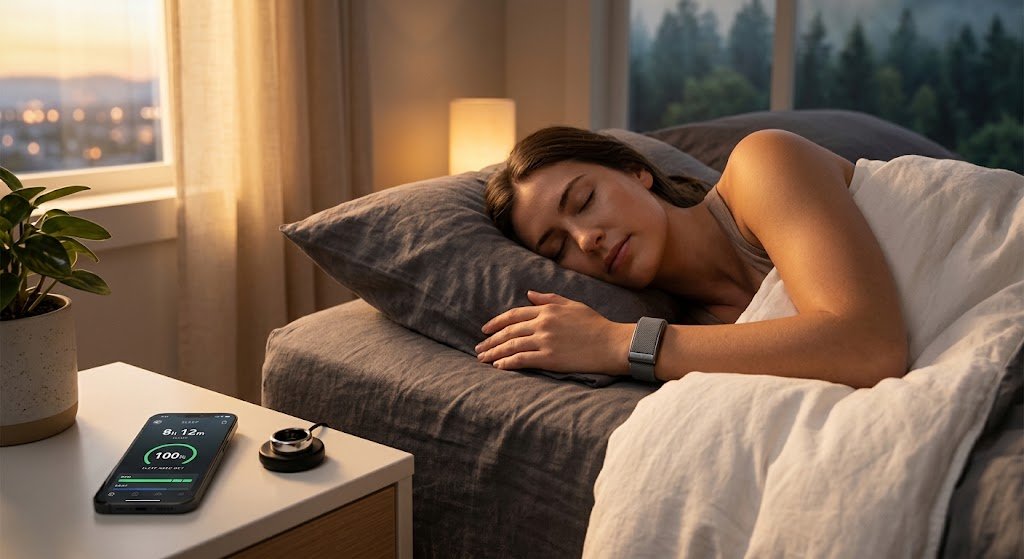
If you have ever woken up feeling like you were hit by a freight train despite spending eight hours in bed, you are not alone. Millions of people struggle with sleep quality without ever understanding why. Over the last few years, fitness wearables have shifted focus from just counting steps to solving the mystery of night-time rest. Among these devices, WHOOP—specifically the WHOOP 4.0—has emerged as one of the most talked-about devices on the market.
While marketed broadly as a health and athletic performance strap, many users buy WHOOP strictly for its sleep capabilities. But is it worth the recurring subscription cost if your main goal is simply getting a better night’s rest?
In this comprehensive review, we will break down how WHOOP handles sleep tracking, how accurate it really is, how its features stack up against the competition, and whether it deserves a spot on your wrist.
1. What Is WHOOP and How Does It Track Sleep?
Unlike a traditional smartwatch, WHOOP has no screen, no buttons, and no digital clock. It doesn’t ping you with text messages or flash notifications while you try to relax. It is a minimalist, lightweight sensor that wraps around your wrist, bicep, or inside specialized WHOOP apparel.
To track your sleep, the sensor rests against your skin and uses tiny light sensors called photoplethysmography (PPG). These sensors shine light into your blood vessels to measure blood flow. From this pulse signal, WHOOP calculates two key metrics:
- Heart Rate (HR): How fast your heart is beating each minute.
- Heart Rate Variability (HRV): The microscopic variation in time between consecutive heartbeats.
HRV is a key indicator of how well your nervous system is balanced. A higher HRV generally means your body is rested, relaxed, and ready to tackle stress, while a sudden drop in HRV usually points to physical exhaustion, alcohol consumption, mental stress, or an oncoming illness.
Alongside cardiovascular metrics, WHOOP uses a multi-axis accelerometer to detect motion. By combining your heart patterns, skin temperature changes, and movement, WHOOP’s algorithms automatically determine when you fall asleep, when you wake up, and how long you spend in each stage of sleep.
2. Unpacking the Sleep Metrics: What the App Actually Tells You
Every morning, WHOOP syncs your data to its companion mobile app, presenting your rest through three primary lenses:
A. Total Sleep vs. “Sleep Need”
Most basic sleep trackers simply tell you how many hours you slept. WHOOP goes a step further by calculating your personalized Sleep Need. Your daily Sleep Need is based on four factors:
- Baseline Need: The natural amount of sleep your body needs (typically around 7.5 to 8.5 hours).
- Recent Strain: How much physical and mental stress you placed on your body during the previous day.
- Sleep Debt: Any accumulated sleep you missed over recent nights.
- Naps: Any rest you took during the afternoon.
If you hit the gym hard or had a stressful workday, WHOOP will automatically adjust your target bedtime, telling you exactly how much sleep you need to feel 100% recovered versus just getting by.
B. Sleep Stages Breakdown
WHOOP breaks your night into four primary phases:
- Awake Time: Micro-awakenings you might not even remember.
- Light Sleep: The transitional stage where your body settles down.
- Deep Sleep (Slow-Wave Sleep): The physical repair phase where muscles rebuild, tissue heals, and growth hormone is released.
- REM Sleep (Rapid Eye Movement): The mental repair phase where your brain consolidates memories, processes emotions, and dreams.
C. Sleep Performance & Efficiency
Rather than giving you a vague “grade,” WHOOP calculates your Sleep Performance Score as a simple percentage: the amount of sleep you got divided by the amount of sleep your body needed. It also tracks Sleep Efficiency—the percentage of time spent in bed where you were actually sleeping rather than tossing and turning.
3. How Accurate Is It? What the Science Says
When evaluating any wearable sleep device, accuracy is the most critical factor. The gold standard for measuring sleep in medical science is called Polysomnography (PSG)—a laboratory test where clinical technicians monitor brainwaves, eye movements, and breathing patterns overnight.
How does WHOOP perform when tested against medical-grade laboratory equipment?
A systematic literature review published in JMIR mHealth and uHealth evaluated recent-generation wearables against clinical PSG. The researchers found that WHOOP demonstrated remarkably low disagreement with gold-standard laboratory tests for Total Sleep Time (showing an average variance of just −1.4 minutes). It also performed accurately in estimating light and deep sleep stages. However, like almost all wrist-worn devices, it struggled slightly more with pinpointing the exact start and end of REM sleep, overestimating REM duration by an average of 21 minutes compared to brainwave monitoring.
Furthermore, a comprehensive validation review published in medRxiv confirmed that WHOOP displays high accuracy for heart rate and heart rate variability metrics during sleep. Research shows that WHOOP reaches nearly 99% agreement with electrocardiogram (ECG) benchmarks for sleeping heart rate metrics.
The Bottom Line on Accuracy: While no wrist strap can fully replace a hospital sleep lab, research confirms that WHOOP is among the most accurate consumer devices available for tracking total sleep duration and heart rate metrics.
4. WHOOP vs. Oura Ring: The Ultimate Sleep Comparison
If you are researching sleep trackers, you have almost certainly bumped into the Oura Ring. Both devices sit at the top of the consumer sleep tech pyramid, but they take very different approaches.
When comparing the design and features of these two devices, their distinct approaches become clear. The WHOOP 4.0 is a fabric wristband or bicep strap designed primarily to monitor athletic strain and physical recovery, whereas the Oura Ring (Gen 3 and Ring 4) takes the form of a lightweight smart ring focused on daily rest, sleep, and overall wellness. Neither device includes a digital screen, allowing both to operate subtly in the background without screen distractions.
Where they differ most is in how you charge, pay for, and interact with them. WHOOP utilizes a unique slide-on battery pack that charges the device while you wear it, enabling continuous 24/7 tracking without removal, while Oura relies on a traditional desktop charging dock. For pricing, WHOOP operates entirely on a membership model costing between $20 and $30 per month with no upfront hardware fee, whereas Oura requires a $299 to $499 upfront hardware purchase alongside a $5.99 monthly subscription. Finally, their app experiences reflect their core audiences: WHOOP delivers direct, performance-driven coaching for active users, while Oura provides an encouraging, wellness-focused tone designed for general health tracking.
Key Differences:
- Comfort & Wearability: Oura is worn as a sleek ring on your finger, which many people find less intrusive while sleeping than a wristband. However, WHOOP offers a slide-on battery pack, meaning you never have to take the band off to charge it—eliminating gaps in your data.
- App Vibe & Coaching: As highlighted in comparative reviews by The Independent, the coaching styles of these two apps differ significantly. Oura acts like a gentle wellness guide, encouraging you to rest when you’re tired. WHOOP acts more like an intense athletic coach, telling you exactly how many hours of sleep you need down to the minute if you want to push your limits the next day.
- Data Depth: A review in Gene Food noted that while Oura excels in simple daily scores, WHOOP provides a deeper breakdown of continuous cardiovascular strain and sleep debt trends over time.
5. What Makes WHOOP Great for Sleep? (Pros)
- No Screen Light Pollution: Because there is no screen, WHOOP will never light up your bedroom in the middle of the night when you move your arm.
- Actionable Sleep Coaching: The built-in “Sleep Planner” does not just analyze last night’s sleep; it tells you when to go to bed tonight based on your personal goals (e.g., “Peak Performance,” “Perform,” or “Get By”).
- Haptic Silent Alarm: You can set a gentle vibrating alarm on your wrist that wakes you up during your lightest phase of sleep within a designated window, leaving your partner undisturbed.
- Illness & Stress Detection: Because WHOOP monitors respiratory rate and skin temperature deviation overnight, it often flags early physical stress or respiratory illness before you notice major symptoms.
6. Where WHOOP Falls Short (Cons)
- Ongoing Membership Model: You do not “own” WHOOP in the traditional sense. You pay a continuous monthly or yearly membership fee. Over two or three years, this makes WHOOP significantly more expensive than standalone hardware purchases.
- Wrist-Band Distractions: Some users find wearing a fabric band to bed slightly uncomfortable, especially during hot summer nights when the band can absorb sweat.
- Over-Fixation on Data (“Nocebo Effect”): Waking up, checking your phone, and seeing a “red” recovery score can occasionally create a negative psychological effect. You might feel tired simply because the app told you that you didn’t get enough REM sleep, even if you felt fine when you first opened your eyes.
7. The Final Verdict: Is WHOOP Worth It Just for Sleep?
If you are an active individual, an athlete, or someone who wants to understand how lifestyle habits—like late-night meals, alcohol, or intense workouts—directly impact your body’s ability to recharge, WHOOP is an outstanding tool. Its sleep-need calculations and cardiovascular tracking are backed by solid clinical research and offer unmatched daily guidance.
However, if you are only interested in tracking basic sleep duration, dislike wearing wristbands to bed, or hate paying ongoing subscription fees, a dedicated smart ring (like Oura) or an under-mattress sleep pad might be a better fit for your lifestyle.
References
- JMIR mHealth and uHealth (2024): Accuracy of Fitbit Charge 4, Garmin Vivosmart 4, and WHOOP Versus Polysomnography: Systematic Review. Evaluating wearable agreement against clinical PSG benchmarks.
- medRxiv Systematic Review (2024): Accuracy, Utility and Applicability of the WHOOP Wearable Monitoring Device in Health, Wellness and Performance. Assessing sleep stage and heart rate accuracy.
- MDPI Sensors Journal (2025): Wearing WHOOP More Frequently Is Associated with Better Biometrics and Healthier Sleep and Activity Patterns. Validation of sleep duration and HRV precision.
- The Independent (2026): Whoop vs Oura Ring Review: Wearable Sleep and Health Trackers Tested Side-by-Side. Evaluating real-world user experience, app coaching, and design differences.
- Gene Food Review (2025): Oura Ring vs. Whoop Strap: Which Sleep Tracker is Best? Comparative analysis of data load, comfort, hardware efficiency, and recovery scores.



Leave a Reply