

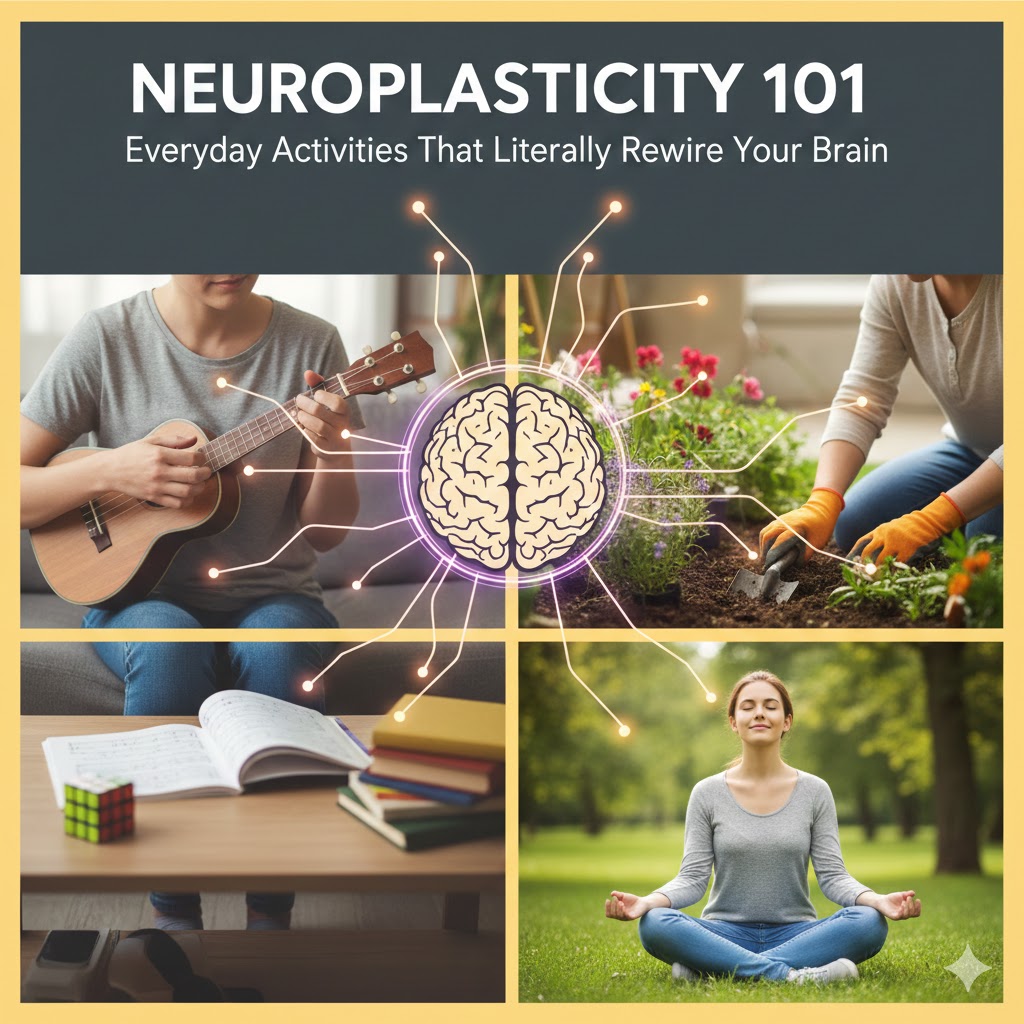
The human brain is not a fixed machine; it is a living, changing network that constantly reshapes itself in response to what you do, think, and experience. This ability to change is called neuroplasticity, and it is one of the most hopeful ideas in modern brain science. It means your daily choices can either reinforce old patterns or help you build new, healthier ones.
This article explains what neuroplasticity is in simple terms and then focuses on practical, everyday activities that help “rewire” your brain in the direction you actually want to go.
What Neuroplasticity Really Means
Neuroplasticity is the brain’s ability to reorganize itself by forming new connections between neurons and modifying existing ones. When you repeat a thought or behavior, the brain strengthens the pathways involved in that pattern, making it easier to activate next time.
A few key ideas make neuroplasticity easier to understand:
- “Neurons that fire together, wire together.” When groups of neurons are activated at the same time, their connections tend to strengthen, so that pattern becomes more automatic in the future.
- “Use it or lose it.” Connections that are rarely used can weaken over time, freeing up resources for circuits that are used more often.
- Plasticity is lifelong. While brains are especially flexible in childhood, adults of all ages can still grow new connections and strengthen existing ones with focused, repeated practice.
Neuroplasticity is neutral. The brain will adapt to whatever is repeated, whether that is practicing a new language, doomscrolling late at night, or staying stuck in worry. The question is not “Is your brain changing?” but “What are you training it to do?”
How Learning New Skills Rewires Your Brain
One of the most powerful drivers of neuroplasticity is learning something genuinely new and challenging. When you step outside your comfort zone and practice a new skill, the brain has to recruit fresh networks, coordinate different regions, and refine those circuits over time.
Great examples of “plasticity‑rich” skills include:
- Learning a new language
- Playing a musical instrument
- Dancing or learning complex movement patterns
- Coding, design, or other technical skills
- Artistic skills like drawing, painting, or sculpting
What matters most is the combination of novelty, challenge, and repetition. Passive consumption (like watching endless videos about guitar) barely moves the needle; active practice (actually playing guitar, making mistakes, and improving) drives real change.
How to start:
- Pick one skill that feels exciting and a little intimidating.
- Commit to 20–30 minutes of focused practice most days of the week.
- Expect early sessions to feel clumsy; that discomfort is exactly when the brain is working hardest to build new pathways.
Movement: Exercise as Brain Fertilizer
Physical activity is not just good for the body; it is one of the most reliable ways to support brain health and plasticity. When you move, your brain gets more blood flow, oxygen, and nutrients. Regular exercise also supports the release of growth factors that help neurons survive, grow, and form new connections.
Different types of movement help in different ways:
- Aerobic exercise (brisk walking, running, cycling, swimming) improves blood flow and supports regions involved in memory and learning.
- Strength training challenges coordination, focus, and body awareness while supporting mood and metabolic health.
- Mind–body practices like yoga, tai chi, or qigong combine physical movement with attention and breath, training both body and mind at the same time.
You do not need extreme workouts to benefit. Consistency is more important than intensity.
How to start:
- Aim for most days of the week to include at least 20–30 minutes of movement.
- Mix in two sessions of strength training, even if it is just bodyweight exercises at home.
- If you sit for long periods, add short “movement snacks” during the day: 3–5 minutes of walking, stretching, or stair climbing.
Mental Training Beyond Scrolling
The brain also needs mentally challenging activity to stay sharp. Many modern habits—like constantly flipping between apps or skimming headlines—keep attention shallow and scattered. Deliberate mental training does the opposite: it invites deep focus, effort, and complexity.
Examples of brain‑engaging activities include:
- Reading books that stretch your understanding
- Strategy games, puzzles, and logic challenges
- Learning platforms or courses in new subjects
- Writing, journaling, or long‑form content creation
The key is to pick tasks that require concentration and are just beyond your current level, so you feel challenged but not overwhelmed. This “sweet spot” is where the brain is pushed to adapt and grow.
How to start:
- Trade 15 minutes of aimless scrolling each day for a more demanding activity (like reading, a language app, or a puzzle).
- Turn it into a ritual: same time, same place, phone on “Do Not Disturb.”
- Track small wins: how many pages, new words, or problems you complete.
Social Connection as a Brain Workout
Human brains are wired for connection. Social interaction engages many different systems at once: language, memory, emotion, self‑control, and empathy. That complexity makes social life a potent driver of plasticity.
Healthy relationships and regular interaction can help:
- Support mood and reduce feelings of isolation
- Challenge your thinking as you encounter different perspectives
- Keep memory and language skills active as you recall details and share stories
In contrast, chronic loneliness and disconnection can contribute to stress, low mood, and cognitive decline over time. Social fitness is just as real as physical fitness, and it benefits the brain in similar ways.
How to start:
- Schedule at least one meaningful conversation or activity with another person each week, ideally in person.
- Join a class, club, or meetup that aligns with your interests so you combine social time with learning.
- When you are with others, put your phone away and practice being fully present.
Mindfulness and Attention Training
Modern life constantly pulls attention in different directions. Mindfulness and related practices train the mind to notice what is happening in the present moment and gently return focus when it wanders. Over time, this repetition changes how the brain handles distraction and stress.
Common forms of attention training include:
- Breath‑focused meditation
- Body scans and somatic awareness practices
- Mindful walking, eating, or daily routines
- Short “pauses” during the day to check in with the body and breath
These practices can help calm overactive stress circuits and strengthen regions involved in self‑control and emotional regulation. The changes are gradual, but they accumulate if you stick with the practice.
How to start:
- Begin with 3–5 minutes a day, sitting comfortably and focusing on the breath.
- Expect the mind to wander; the “rewiring” happens each time you notice that and gently return attention.
- Gradually increase the duration as it becomes more familiar.
Environment, Novelty, and Sensory Input
Your surroundings constantly feed information into your nervous system. An environment that is monotonous, stressful, or overloaded with noise and notifications trains the brain to be either numb or hyper‑reactive. An environment rich in healthy stimulation encourages curiosity and flexibility.
You can support positive plasticity by:
- Spending more time in nature or green spaces
- Changing your routine: new routes, cafés, parks, or workspaces
- Reducing background noise and clutter to make it easier to focus
- Designing “digital‑light” zones or times at home
Even small changes—a new walking route, a different type of music, a fresh arrangement of your workspace—can nudge the brain out of autopilot and back into learning mode.
How to start:
- Plan one “novelty day” or “novelty block” each week where you intentionally try something slightly different.
- Keep one area of your home as a calm, low‑clutter space for reading, thinking, or creative work.
- Turn off non‑essential notifications to reduce constant micro‑distractions.
Habits, Repetition, and Making Change Stick
Neuroplasticity does not work like a light switch; it works like a training program. Just as a single workout does not transform your body, a single meditation or language lesson does not transform your brain. It is the repetition—over days, weeks, and months—that drives lasting change.
A few principles help new brain‑friendly habits stick:
- Start small and consistent. It is better to do 10 minutes a day than one intense session once a month.
- Link habits to existing routines. Attach a new behavior (like 5 minutes of practice) to something you already do (like morning coffee).
- Protect your sleep. Many brain changes are consolidated during sleep, so sleep quality and duration matter for plasticity.
- Expect resistance. Old patterns are familiar, so the brain will nudge you back toward them. Recognizing this as part of the process makes it easier to stay the course.
Over time, the new pattern becomes more automatic because the underlying networks strengthen and the brain treats that behavior as the default.
Negative Neuroplasticity: What You May Be Training Without Realizing
Because the brain is always adapting, it is also possible to train patterns you do not actually want. Repeated experiences like chronic stress, multitasking, late‑night scrolling, or substance misuse can reshape circuits toward anxiety, distraction, and impulsivity.
Common examples of unintentional “negative plasticity” include:
- Checking the phone at every hint of boredom, training shallow attention
- Constant multitasking, training the brain to stay scattered
- Repeated worry loops, strengthening anxious thinking patterns
- Sedentary routines that starve the brain of movement‑driven benefits
The goal is not perfection but awareness. Once you notice what you are practicing, you can gradually replace one unhelpful pattern with something more supportive.
A Sample “Brain‑Rewiring” Day
To see how this all fits together, imagine a simple day that weaves in several plasticity‑boosting activities:
- Morning: A 10–15 minute walk outside, followed by 5 minutes of breath‑focused meditation before checking messages.
- Midday: A 20‑minute block of focused skill learning (like language practice, a course module, or an instrument).
- Afternoon: A short session of strength or aerobic exercise, even if it is just bodyweight exercises and brisk walking.
- Evening: Time with a friend or family member, a phone‑free meal, and 20 minutes of reading or a mentally engaging hobby before bed, with screens off ahead of sleep.
This is not a rigid prescription—just a template. You can swap in activities that fit your goals and schedule, as long as they share the same ingredients: challenge, repetition, presence, and care for your body.
Neuroplasticity means that your brain is never completely “stuck.” Even if you have spent years in certain habits or struggled with focus, mood, or motivation, small changes practiced consistently can begin to carve out new pathways. You do not need to overhaul your life overnight. Pick one activity from this article—learning, moving, connecting, or paying attention differently—and give it a little space every day. Over time, those minutes add up to real structural change in the organ that shapes how you think, feel, and live.



Leave a Reply