

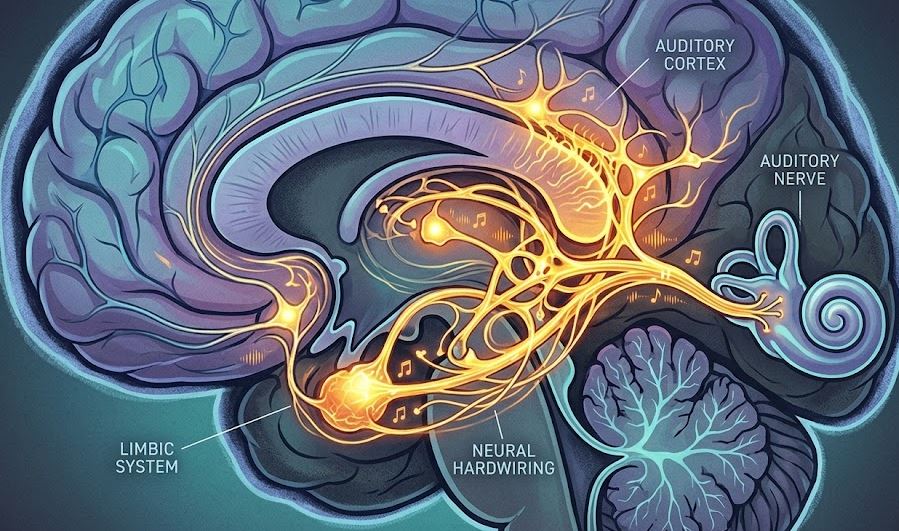
For the vast majority of people, tinnitus begins as a fleeting ghost. It is the ringing in the ears after a loud concert, the dull hum following a bout of the flu, or the momentary whistle that vanishes as quickly as it arrived. But for a significant portion of the population, that ghost doesn’t leave. It moves in, unpacks its bags, and becomes a permanent resident of the internal landscape.
When tinnitus persists for years, it undergoes a fundamental transformation. It stops being a “symptom” of the ears and becomes a “state” of the brain. To the person suffering, it feels like a physical sound hitting the eardrums, but the reality is far more complex. Chronic tinnitus is a masterpiece of maladaptive neuroplasticity. It is the result of a brain that has tried so hard to “fix” a hearing deficit that it has accidentally hardwired a permanent error into its own software.
To understand how to live with—and eventually quiet—this sound, we must look deep into the folds of the auditory cortex, the emotional centers of the limbic system, and the chemical messengers that dictate how we perceive our world.
1. The Genesis: From “Ear Damage” to “Brain Signal”
It is a common misconception that tinnitus is an ear disease. While it is true that most cases are triggered by the ear—specifically damage to the tiny hair cells in the cochlea—the “sound” you hear for years afterward is actually generated by the brain.
The “Phantom Limb” Phenomenon
The best way to visualize chronic tinnitus is through the lens of a phantom limb. When a soldier loses an arm in combat, they often continue to feel excruciating itches or cramps in the hand that is no longer there. Why? Because the area of the brain responsible for that hand (the somatosensory cortex) is still active. It is “starved” for input, so it begins to fire spontaneously, creating “phantom” sensations to fill the void.
Chronic tinnitus is the auditory version of this. When you lose high-frequency hearing—even a tiny amount that doesn’t show up on a standard audiogram—the auditory cortex stops receiving signals in those frequency bands. The brain, which hates silence, attempts to compensate. It turns up the “gain” or internal volume of those specific neurons. Eventually, these neurons become so sensitive that they fire without any external sound at all. This is the birth of the “phantom sound.”
2. The Hardwiring: How Neuroplasticity Goes Wrong
We are often told that neuroplasticity is a miracle—it’s how we learn languages, play instruments, and recover from strokes. But neuroplasticity is a double-edged sword. In the case of chronic tinnitus, your brain’s ability to change is exactly what makes the ringing permanent.
Map Reorganization
The auditory cortex is organized like a piano keyboard (tonotopic map). Low frequencies are processed at one end, and high frequencies at the other. When the “high keys” on the piano (the ears) stop working, the brain doesn’t just leave those neurons alone. Instead, the neurons in the neighboring “keys” begin to invade that territory.
This creates a massive “traffic jam” of neural activity. Instead of a clean map where every sound has its place, you end up with a cluster of hyper-active neurons all firing at once. Over years, this “cluster” becomes physically reinforced. The brain builds stronger synaptic connections to support this new activity, essentially “hardwiring” the tinnitus into your neural architecture.
Synchrony: The Rhythmic Pulse
In a healthy brain, neurons fire in a somewhat scattered, asynchronous way. However, in people with chronic tinnitus, researchers have found that large groups of neurons begin to fire in perfect, rhythmic synchronization. This “picket fence” of activity creates a signal so strong and so consistent that the brain perceives it as a loud, external tone. Because this firing pattern is repetitive, the brain learns it as a “habit,” much like your heart knows how to beat without you thinking about it.
3. The Psychiatric Bridge: Tinnitus and the Limbic System
If tinnitus were just a neutral sound, most people would eventually stop noticing it (a process called habituation). We don’t “hear” the hum of our refrigerator or the sound of the wind outside after a few minutes because the brain labels those sounds as “meaningless.”
The reason tinnitus becomes a life-altering psychiatric issue for many is due to the Limbic System—the part of the brain responsible for emotion, memory, and the “fight or flight” response.
The Threat Loop
When tinnitus first appears, it is often accompanied by fear. “Is my hearing going? Do I have a brain tumor? Will I ever sleep again?” This fear triggers the amygdala (the brain’s alarm system). Once the amygdala is involved, the brain marks the tinnitus sound as a threat.
The human brain is biologically incapable of ignoring a threat. If you are in a forest and hear a twig snap, you focus on it. Because the brain views tinnitus as a “predator” in the room, it directs 100% of its attention toward it.
- This constant attention strengthens the neural pathways (neuroplasticity).
- The stronger pathways make the sound louder.
- The louder sound causes more anxiety.
- The anxiety triggers the limbic system to focus even harder.
This is the Tinnitus Distress Loop, and it is the primary reason why the sound feels “stuck” for years.
4. The Neurochemistry of Noise: Glutamate and GABA
At a molecular level, chronic tinnitus is often a battle between two primary neurotransmitters: Glutamate (the “go” signal) and GABA (the “slow down” signal).
In a healthy auditory system, there is a delicate balance between these two. Glutamate excites the neurons so they can pass sound signals along, while GABA inhibits them so they don’t fire too much. In chronic tinnitus, this balance is often destroyed. There is an overabundance of glutamate and a deficiency of GABA. This creates a state of “excitotoxicity,” where the neurons are essentially stuck in the “on” position, screaming at each other with no way to turn the volume down.
This is why stress and psychiatric issues like Generalized Anxiety Disorder (GAD) exacerbate tinnitus. Stress depletes GABA and floods the brain with glutamate and cortisol, literally fueling the fire of the ringing.
5. Is it Permanent? Breaking the Habituation Barrier
If the brain is “hardwired,” does that mean it’s impossible to find silence? Not necessarily. While the neural signal might remain, the perception of that signal is highly plastic.
The Goal: Habituation
Habituation is the process of moving the tinnitus signal from the “conscious, threatening” part of the brain to the “subconscious, meaningless” part. Think of it like wearing a watch. When you first put it on, you feel the strap on your wrist. Within five minutes, your brain has “habituated” to the sensation, and you no longer feel it unless you specifically think about it.
To achieve this with years-long tinnitus, several steps are usually required:
- Cognitive Reframing (CBT): By working with a therapist, you can “unplug” the limbic system. If you can convince your brain that the sound is not a threat, the amygdala stops firing. When the alarm stops, the brain naturally begins to pay less attention to the noise.
- Sound Enrichment: Feeding the “starved” auditory cortex with external sound (white noise, nature sounds, or hearing aids) can reduce the “gain” the brain has applied to the tinnitus.
- Neuroplasticity “Reset”: New therapies, such as Bimodal Neuromodulation (Lenire or Neosensory), use dual-sensory input (like sound paired with tongue or skin stimulation) to “distract” the brain and force it to reorganize its tonotopic map in a more healthy way.
6. The Long View: Life with Sustained Tinnitus
Living with a sound for years is an act of endurance. It is a psychiatric challenge as much as a physical one. However, the very same neuroplasticity that “hardwired” the sound into your brain is the same mechanism that can help you move past it.
The brain is never “fixed” in place. It is a dynamic, shifting organ. By managing stress, utilizing sound therapy, and addressing the psychiatric components of the distress, the “hardwiring” can be softened. The ringing may not completely vanish into a vacuum of silence, but it can fade into the background, becoming nothing more than a quiet, unnoticed hum in a life that is once again full of meaning and joy.
A Final Note for the Reader
If you have been hearing this noise for years, understand that it is not “all in your head” in a way that dismisses your pain. It is physically in your head—in the very synapses and circuits of your brain. But just as those circuits were built, they can be taught to ignore the noise. The journey to silence begins with understanding the science of the sound.



Leave a Reply