

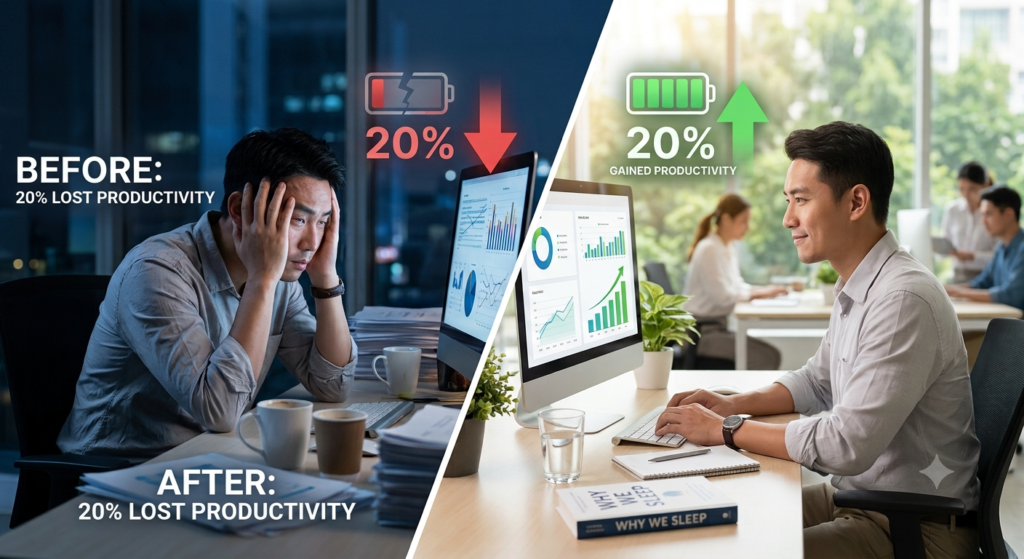
Imagine showing up to work every single day, sitting at your desk for eight hours, but only getting six hours of actual work done.
You aren’t scrolling through social media or taking long breaks. You are sitting right there, staring at your screen, trying your hardest to focus. Yet, tasks that usually take twenty minutes are dragging on for an hour. You read the same email three times just to understand it. Your brain feels wrapped in cotton.
This invisible drain on your workday is called presenteeism—being physically present at your job, but operating at a fraction of your actual mental capacity.
The primary culprit behind this issue isn’t a lack of discipline or coffee. It is sleep deprivation.
According to a landmark study led by Harvard Medical School, untreated sleep problems cost companies tens of billions of dollars each year in lost productivity. For the individual worker, lack of sleep translates to a hidden “tax” on your brain, cutting your cognitive speed, memory, and decision-making by 20% or more.
The good news? You don’t need a medical degree or an expensive overhaul of your life to fix it. By understanding how sleep drives human performance and applying a few straightforward habits, you can eliminate brain fog, protect your health, and reclaim that lost 20% of your daily output.
The Hidden Cost of “Toughing It Out”
In today’s fast-paced world, pulling late nights is often treated as a badge of honor. We tell ourselves we can “sleep when we’re dead” or that a extra cup of coffee will fix the morning slump.
However, your brain does not work like a machine that can simply run on low fuel.
When you miss out on quality sleep, several things happen to your mind and body at a deep biological level:
- Slower Reaction Times: Your brain’s ability to process information slows down significantly.
- Impaired Working Memory: You forget small details, mix up instructions, or lose your train of thought midway through a sentence.
- Poor Emotional Control: The part of your brain that regulates stress (the amygdala) becomes overactive, making you more irritable, anxious, and prone to burnout.
- Reduced Problem-Solving Ability: Complex tasks that require creative thinking become exponentially harder.
Key Takeaway: Sleeping less than six hours a night doesn’t give you two extra hours of productive time. It makes the remaining hours you spend awake vastly less effective.
A major economic analysis by the RAND Corporation found that individuals who sleep less than six hours per night have a 13% higher mortality risk and lose around six working days per year to absenteeism or reduced performance compared to those sleeping seven to nine hours.
Understanding Your Internal Clock
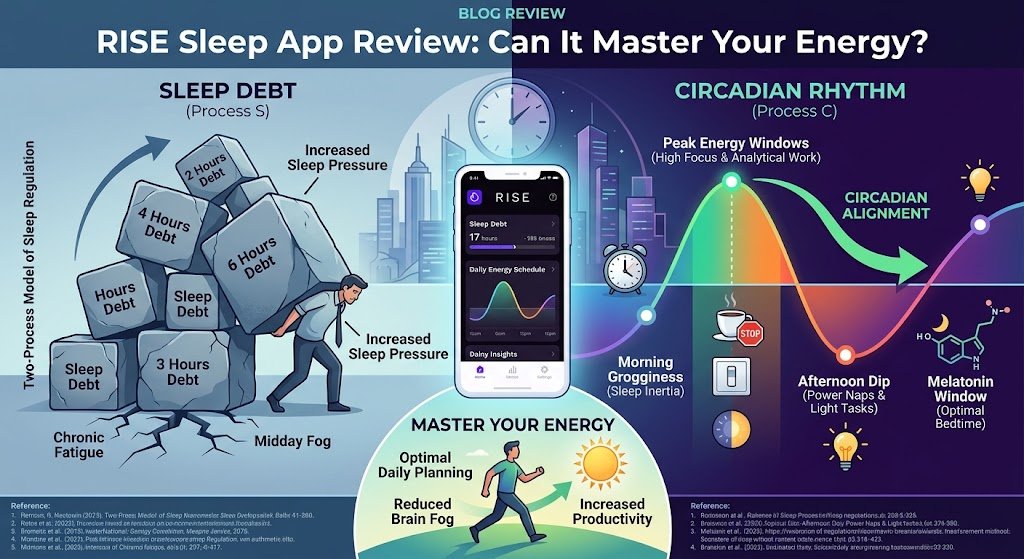
To fix your sleep, you first need to understand the two main forces that control it: Circadian Rhythm and Sleep Pressure.
[ Wake Up ]  --->  Adenosine builds up all day (Sleep Pressure)  --->  [ Sleepy ]
[ Morning ]  --->  Light resets your internal master clock      --->  [ Alert ]
1. Your Circadian Rhythm
This is your body’s built-in 24-hour internal clock. It operates in the background, signaling your brain when to feel alert and when to feel drowsy. It relies heavily on natural light cues from your environment.
2. Sleep Pressure (Adenosine)
From the moment you wake up, a chemical called adenosine builds up in your brain. The longer you stay awake, the more adenosine accumulates, creating “sleep pressure.” When you sleep, your brain clears this chemical away, resetting the counter for the next day.
When these two systems are aligned, falling asleep is effortless, and waking up feels natural. When they are out of sync—due to irregular sleep schedules, late-night screen time, or poor habits—your sleep quality plummets, leaving you exhausted even if you stayed in bed for eight hours.
5 Practical Tips to Fix Sleep Deprivation and Reclaim Your Output
You don’t need a total lifestyle overhaul to see massive improvements in your sleep and workplace focus. Implementing these five science-backed protocols can help you fall asleep faster, sleep deeper, and wake up ready to perform.
1. Anchor Your Wake-Up Time
The single most powerful habit for regulating your sleep cycle is waking up at the exact same time every day—including weekends.
When your wake-up time constantly shifts (for example, waking up at 7:00 AM on weekdays and 10:00 AM on Saturdays), you give yourself a form of “social jetlag.” Your body gets confused about when it should release hormones like cortisol (which wakes you up) and melatonin (which helps you sleep).
- Action Step: Pick a wake-up time you can realistically stick to seven days a week. Set your alarm and stick to it, even if you went to bed a little later than usual the night before. Within two weeks, your body will naturally start making you tired at the right time every evening.
2. Get Bright Light Exposure First Thing in the Morning
Light is the primary signal your brain uses to set its internal clock. When sunlight hits the photoreceptors in your eyes early in the morning, it triggers a chain reaction:
- It immediately stops the production of melatonin (the sleep hormone).
- It triggers a healthy spike in cortisol to boost your energy and mood.
- It sets a timer for your brain to start producing melatonin again roughly 12 to 14 hours later.
- Action Step: Within 30 to 60 minutes of waking up, step outside for 10 to 15 minutes of natural sunlight. If it’s cloudy, stay out a bit longer. Avoid looking at the sun directly, but leave your sunglasses off if it is safe to do so.
3. Set a “Caffeine Curfew”
Caffeine works by blocking adenosine receptors in your brain. It doesn’t actually remove sleep pressure; it just hides it from your brain.
The problem is that caffeine has a half-life of roughly 5 to 7 hours. If you drink a cup of coffee at 3:00 PM, half of that caffeine is still actively circulating in your system at 10:00 PM. Even if you manage to fall asleep, residual caffeine prevents your brain from reaching deep, restorative stages of sleep (slow-wave sleep).
- Action Step: Establish a strict caffeine cutoff time 8 to 10 hours before you plan to go to bed. If your goal is to sleep by 10:00 PM, drink your last cup of coffee or tea by 12:00 PM or 2:00 PM at the latest.
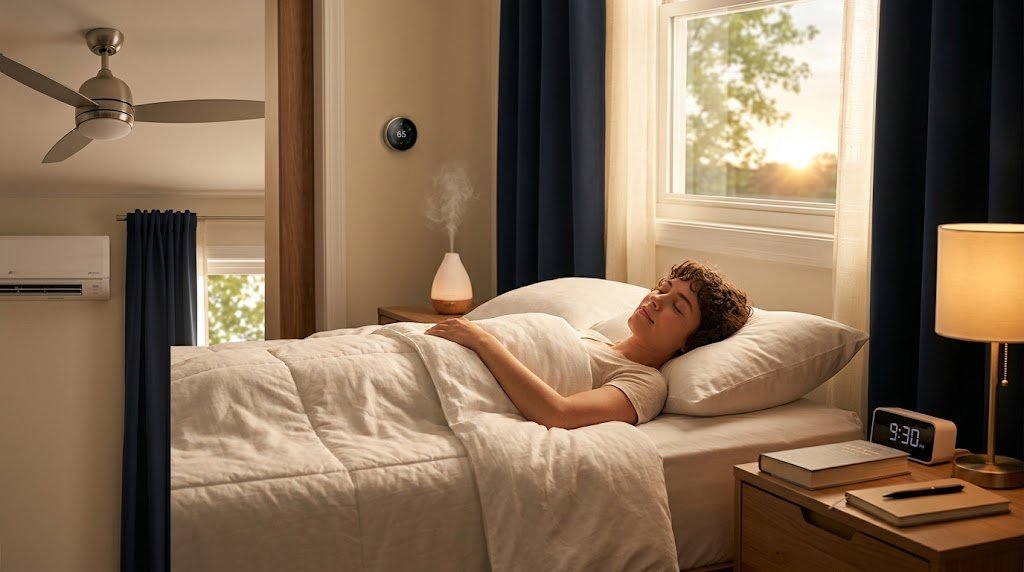
4. Optimize Your Sleep Sanctuary (Cool and Dark)
Your bedroom environment plays a huge role in how well you sleep. To initiate sleep, your core body temperature needs to drop by about 2 to 3 degrees Fahrenheit. If your room is too warm, your body struggles to cool down, leading to restless tossing and turning.
- Action Step for Temperature: Set your thermostat between 65°F and 68°F (18°C–20°C). If you don’t have air conditioning, use a fan or lighter bedding.
- Action Step for Light: Make your bedroom as dark as possible. Use blackout curtains or wear a comfortable eye mask to block ambient light from streetlights or electronics.
5. Create an “Evening Wind-Down” Routine
You cannot expect your brain to sprint at 100 miles per hour all day, stare at a bright smartphone screen answering work emails until 10:59 PM, and then magically fall asleep at 11:00 PM.
Your mind needs a transition zone to shift from high-stress wakefulness to restful sleep.
- Action Step: Dedicate the final 60 minutes of your evening to winding down. Turn off bright overhead lights and switch to dim lamps. Put away work devices and smartphones (the blue light and stressful content both signal to your brain that it is still daytime). Instead, read a physical book, do light stretching, or listen to calm music.
Measuring Your Results: The 20% Productivity Bump
What does regaining 20% of your workplace efficiency actually look like in real life?
When you consistently get 7 to 8 hours of high-quality sleep, the improvements show up almost immediately:
| Mental Metric | Sleep-Deprived State | Fully Rested State |
| Focus & Attention | Distracted every 5–10 minutes | Deep work blocks lasting 45–90 minutes |
| Decision Making | Second-guessing, slow processing | Clear, confident, and rapid choices |
| Error Rate | High risk of typos, missed details | Sharp attention to detail |
| Stress Threshold | Easily overwhelmed by small setbacks | Calm, structured problem solving |
By eliminating brain fog, you complete tasks faster and with fewer mistakes. Work that used to take you an entire weekend afternoon can often be finished before lunch, freeing up time for your personal life, family, and hobbies.
Summary Checklist for Better Sleep
To put these steps into action starting tonight, use this simple checklist:
- [ ] Same Wake-Up Time: Set an alarm for the same time tomorrow, even if it’s the weekend.
- [ ] Morning Sun: Get 10–15 minutes of outdoor sunlight shortly after waking up.
- [ ] Caffeine Cutoff: Stop drinking caffeinated beverages after 12:00 PM or 2:00 PM.
- [ ] Cool Room: Set your bedroom temperature around 65°F–68°F.
- [ ] Screens Away: Put away phones, tablets, and laptops 60 minutes before bed.
Sleep is not a luxury or a reward you earn after finishing your work. It is the fundamental foundation that makes high performance possible. Fix your sleep hygiene today, and watch your focus, energy, and overall output soar.
References
- Kessler, R. C., Berglund, P. A., Coulouvrat, C., Hajak, G., Roth, T., Shahly, V., Shillington, A. C., Stephenson, J. J., & Walsh, J. K. (2011). Insomnia and the performance of US workers: results from the America Insomnia Survey. SLEEP, 34(9), 1161–1171. https://doi.org/10.5665/SLEEP.1230
- Hafner, M., Stepanek, M., Taylor, J., Troxel, W. M., & van Stolk, C. (2016). Why sleep matters—the economic costs of insufficient sleep: A cross-country comparative analysis. RAND Health Quarterly, 6(4), 11.
- Walker, M. P. (2017). Why We Sleep: Unlocking the Power of Sleep and Dreams. Scribner.
- Mah, C. D., Mah, E. K., Kezirian, E. J., & Dement, W. C. (2011). The effects of extra sleep on athletic performance in college basketball players. SLEEP, 34(7), 943–950. https://doi.org/10.5665/SLEEP.1274
- Bessone, P., Rao, G., Schilbach, F., Schofield, H., & Toma, M. (2021). The economic consequences of increasing sleep among the urban poor. The Quarterly Journal of Economics, 136(3), 1887–1941. https://doi.org/10.1093/qje/qjab013


Leave a Reply