

In a world full of smart watches, fitness rings, and mattress sensors, most sleep trackers try to grade your night’s rest with a single number. You wake up, open an app, and see a “Sleep Score” of 78 out of 100. But what does that score actually mean for your day? If you slept poorly according to your watch, are you supposed to just accept that you’ll have a terrible day?
That is precisely the problem the RISE Sleep & Energy Tracker app (available on iOS and Android) sets out to solve. Instead of grading your past sleep with vague scores, RISE looks forward. It uses the fundamental biology of human sleep to predict your energy levels throughout the day, showing you exactly when you will feel sharp, when you will hit a slump, and when your body is naturally ready to wind down.
If you are tired of trackers that state the obvious without giving you a clear plan, this in-depth review breaks down how RISE works, the science behind it, its top features, and whether it is worth adding to your daily routine.
The Big Difference: Why RISE Dumps the “Sleep Score”
Most sleep apps try to estimate how many minutes you spent in light sleep, deep sleep, and REM (Rapid Eye Movement) sleep. While that sounds impressive, consumer devices often struggle to accurately measure sleep stages compared to medical-grade laboratory equipment. More importantly, knowing you got 18% deep sleep last night doesn’t give you a clear action step for your morning.
RISE throws out sleep stage tracking entirely. Instead, it builds its entire app around two well-established biological principles: Sleep Debt and your Circadian Rhythm.
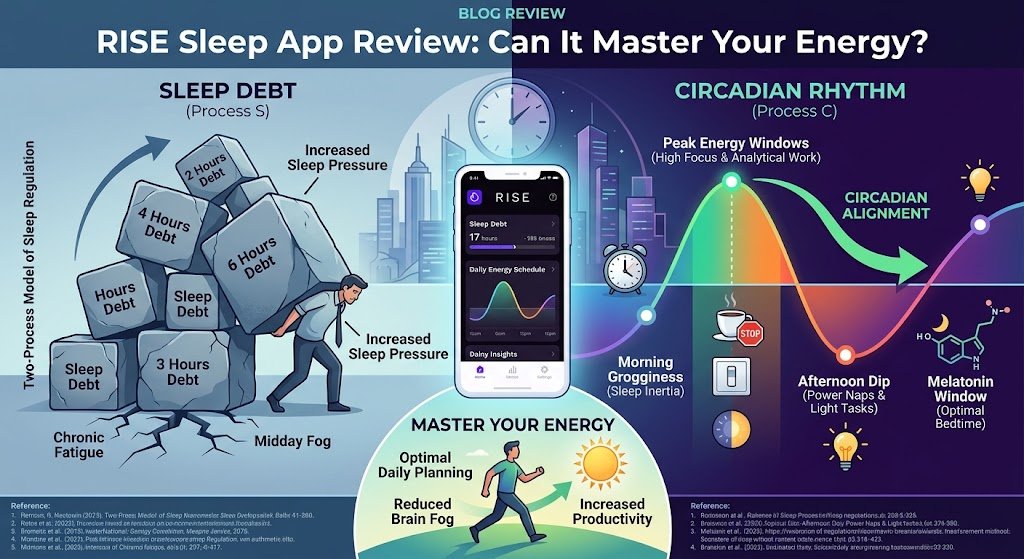
Together, scientists call this the Two-Process Model of Sleep Regulation:
- Process S (Sleep Homeostasis / Sleep Debt): Think of this as your body’s pressure to sleep. From the moment you wake up, a chemical called adenosine builds up in your brain, making you feel progressively heavier and tired. The only way to clear this pressure is to sleep.
- Process C (Circadian Rhythm): This is your internal 24-hour biological clock. Controlled by a tiny region in your brain sensitive to light, your circadian rhythm regulates your body temperature, hormone release, and overall alertness across the day.
Instead of guessing your sleep stages, RISE calculates your real biological sleep needs and maps out your unique daily energy wave.
How RISE Works in Daily Life
Using RISE is straightforward because it is designed to run quietly in the background. Here is a breakdown of how the app functions day-to-day.
1. Zero-Effort Tracking
You don’t need a fancy wristband to use RISE, though it plays very nicely with them if you have one. RISE can track your sleep passively using your smartphone’s built-in motion sensors—noticing when you pick up your phone in the morning and when you set it down at night.
If you already wear an Apple Watch, Garmin, Fitbit, Oura Ring, or Whoop strap, RISE syncs seamlessly through Apple Health or Google Health Connect. It pulls in your existing sleep data, runs it through its proprietary energy algorithm, and updates your profile automatically.
2. Managing Your Sleep Debt
When you first open RISE, the app calculates your individual sleep need (which varies naturally from person to person, usually between 7 and 9 hours). It then calculates your Sleep Debt—the total amount of sleep you owe your body over the last 14 nights.
- Low Sleep Debt (Under 5 hours): You are primed for peak mental focus, better mood regulation, and stronger physical performance.
- High Sleep Debt (Over 10 hours): You are likely suffering from brain fog, daytime drowsiness, and delayed reaction times.
The app’s top priority is helping you keep your sleep debt as low as possible. Rather than telling you to get a unrealistic 9 hours of sleep tonight, RISE gives you manageable goals—like adding 30 extra minutes of rest over the next few nights—to steadily pay down your debt.
3. Mapping Your Daily Energy Curve
The star feature of RISE is its daily energy graph. Rather than viewing sleep as an isolated event that happens at night, RISE treats sleep as the engine that powers your day. The main screen shows a continuous wave representing your predicted alertness from the moment you wake up until you close your eyes.
Here are the key zones RISE identifies for you every day:
- Morning Grogginess (Sleep Inertia): That initial 30 to 90 minutes after waking up where your brain is still clearing out residual sleep hormones. RISE reminds you not to schedule intense, brain-heavy tasks during this window.
- Morning Energy Peak: Your first major wave of high mental performance. This is your prime window for analytical thinking, important meetings, or challenging work projects.
- Afternoon Dip: A natural lull in body temperature and alertness that hits most people in the early to mid-afternoon. RISE signals this as the perfect time to catch up on simple emails, take a walk, or enjoy a 20-minute power nap.
- Evening Wind-Down & Melatonin Window: As light fades, your brain begins releasing melatonin. RISE identifies your ideal window to step away from bright screens, dim house lights, and get into bed, making falling asleep significantly easier.
Real-World Features You Will Actually Use
RISE is packed with practical tools designed to change your daily behavior without feeling overwhelming:
- Caffeine Cutoff Timer: Drinking coffee too late in the afternoon is one of the most common causes of poor sleep quality. RISE calculates your exact caffeine cutoff time based on your internal clock, sending a friendly notification when it is time to switch to water or decaf.
- Evening Wind-Down Prompts: RISE alerts you when your body is entering its natural melatonin release window, encouraging you to finish late-night snacks and turn off high-stress work tasks.
- Calendar Integration: You can export your personalized daily energy curve directly into Google Calendar or Apple Calendar. This allows you to block out your “Peak Focus” times for deep work and keep your “Afternoon Dip” clear of high-stakes presentations.
- Smart Alarm & Gentle Habit Building: RISE includes built-in soundscapes, guided relaxation tracks, and habit trackers to help you establish consistent bedtimes.
Pros and Cons: Is RISE Right for You?
The Good
- Actionable, Future-Focused Data: Tells you what to do today rather than just scolding you for how you slept yesterday.
- No Extra Hardware Required: Works using just your iPhone or Android phone, saving you hundreds of dollars on wearable gadgets.
- Grounded in Proven Biology: Relies on validated scientific principles (sleep debt and circadian rhythms) rather than secret, unproven health scores.
- Seamless Syncing: Easily imports metrics from major wearables like Apple Watch, Garmin, Fitbit, Oura, and Whoop.
The Drawbacks
- Subscription Cost: After a brief 7-day free trial, RISE requires a paid subscription (around $59.99/year).
- Requires Behavioral Consistency: If you rely solely on your phone for tracking (without a wearable), you need to be consistent about putting your phone down when going to bed and picking it up when you wake up.
The Final Verdict
If you are looking for an app that gives you a quick thumbs-up or thumbs-down on last night’s rest, RISE might feel a bit detailed. However, if you suffer from chronic afternoon fatigue, struggle with morning brain fog, or simply want to schedule your workday around your body’s natural biology, RISE is one of the most practical and user-friendly sleep apps available today.
By shifting the conversation away from confusing sleep stages and focusing on actionable daily energy management, RISE gives you back control over how you feel every single day.
Reference List
- Borbély, A. A. (1982). A two-process model of sleep regulation. Human Neurobiology, 1(3), 195–204.
- Grandner, M. A., & Fernandez-Mendoza, J. (2017). The translational neuroscience of sleep: A contextual framework. Endocrinology and Metabolism Clinics of North America, 46(2), 293–306.
- Walker, M. P. (2017). Why We Sleep: Unlocking the Power of Sleep and Dreams. Scribner / Simon & Schuster.
- Czeisler, C. A., & Gooley, J. J. (2007). Sleep and circadian rhythms in humans. Cold Spring Harbor Symposia on Quantitative Biology, 72, 579–597.
- Roenneberg, T., Wirz-Justice, A., & Merrow, M. (2003). Life between clocks: daily temporal patterns of human chronotypes. Journal of Biological Rhythms, 18(1), 80–90.



Leave a Reply