

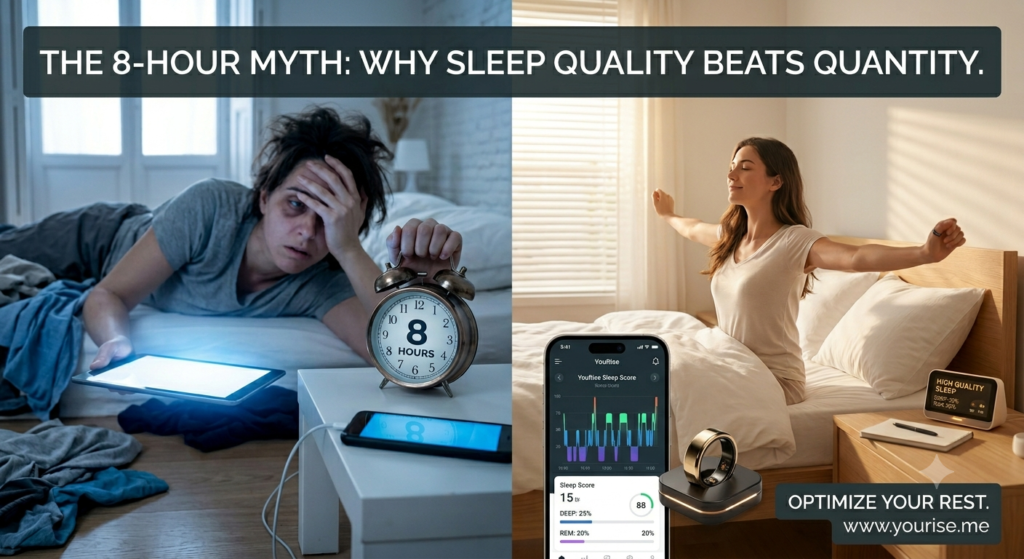
For decades, we have been conditioned to believe in a singular, non-negotiable metric for nocturnal recovery: the eight-hour rule. We track it on our bedside clocks, log it in our fitness applications, and feel an immediate wave of psychological panic if our total time in bed slips below this arbitrary threshold. It is the gold standard of wellness advice, repeated by physicians, media outlets, and well-meaning health gurus alike.
However, modern neuroscience and somnology (the scientific study of sleep) are uncovering a far more nuanced reality. The obsession with pure volume is not only incomplete—it is often counterproductive. The truth is that the “8-hour” rule is an oversimplified myth. Total sleep duration is merely an empty container; what truly matters is what fills that container. In the battle of sleep quality vs quantity, quality emerges as the true driver of cognitive longevity, metabolic health, and emotional resilience.
If you have ever woken up exhausted after a nine-hour stretch of restless sleep, or conversely, felt inexplicably radiant and sharp after a focused six-and-a-half hours, you have experienced this phenomenon firsthand. This comprehensive guide will dismantle the 8-hour sleep myth, explore the biological framework of restorative rest, and teach you exactly how to track and optimize the metrics that actually matter for your daily vitality.
The Physiology of Sleep Architecture: Beyond the Clock
To understand why duration is a flawed metric, we must first examine what happens inside the brain when we drift off. Human sleep is not a homogenous state of unconsciousness. Instead, it is a highly dynamic, choreographed sequence of neurological stages known collectively as sleep architecture.
A single, complete sleep cycle lasts approximately 90 to 110 minutes and consists of two primary states: Non-Rapid Eye Movement (NREM) sleep and Rapid Eye Movement (REM) sleep. Throughout a typical night, an optimized brain will cycle through these stages four to six times. However, the composition of these cycles shifts dramatically as the night progresses.
1. The NREM Stages (Deep Physical Recovery)
NREM sleep is split into three distinct phases, each progressively deeper than the last:
- Stage N1 (Light Sleep): The transitional phase between wakefulness and sleep. The brain produces alpha and theta waves, muscles begin to relax, and you can be easily awakened.
- Stage N2 (Intermediate Sleep): This stage constitutes the largest percentage of our total sleep time. Here, the brain exhibits sudden bursts of rhythmic activity known as sleep spindles and K-complexes. These neuroelectrical events are critical for sensory gating, memory consolidation, and protecting the brain from external disturbances.
- Stage N3 (Slow-Wave Sleep / Deep Sleep): This is the holy grail of physical restoration. The brain generates high-amplitude, low-frequency delta waves. During Stage N3, the pituitary gland releases a surge of human growth hormone (HGH), cellular repair accelerates, tissues regenerate, and the immune system is reinforced. Crucially, the brain’s glymphatic system activates during deep sleep, functioning like a metabolic waste clearance mechanism that flushes out neurotoxic proteins, including beta-amyloid and tau tangles associated with cognitive decline.
2. The REM Stage (Cognitive and Emotional Integration)
Often referred to as “paradoxical sleep,” REM is characterized by high-frequency brain activity that closely resembles active wakefulness. This is the realm of vivid dreaming. During REM, the brain consolidates procedural and spatial memories, synthesizes complex information, and processes emotional experiences, acting as a form of nocturnal psychotherapy. Without sufficient REM sleep, our emotional regulation degrades, creative problem-solving plummets, and our capacity to learn new skills is severely compromised.
The core issue with the 8-hour myth is that it ignores the composition of these cycles. If your sleep is fragmented by frequent micro-arousals—even if you are unconscious for eight full hours—your brain may never spend adequate time in Stage N3 Deep Sleep or REM sleep. You are left with a surplus of light, unrefreshing sleep, leaving your body and mind functionally starved of true rest.
The Sleep Debt Illusion: Why Quantity Alone Deceives You
Many individuals fall into the trap of calculating their sleep health using a simple mathematical formula: $\text{Time Out of Bed} – \text{Time In Bed} = \text{Sleep Status}$. This binary approach creates a dangerous illusion of safety. For example, a professional who goes to sleep at 11:00 PM and gets out of bed at 7:00 AM assumes they have achieved the optimal 8 hours.
However, what if that individual suffered from an elevated number of micro-arousals due to late-night alcohol consumption or a high-cortisol lifestyle? While they believe they slept for 8 hours, their actual Total Sleep Time (TST) might only be 6 hours, with the remaining 2 hours spent in unrecognized, fragmented waking states. More importantly, their macrostructure was disrupted, meaning they missed out on critical cycles of deep slow-wave sleep. This mismatch is what experts call the “Sleep Debt Illusion.”
Conversely, someone who understands their personalized sleep biology might sleep for a highly compressed, uninterrupted 6.5 hours. Because their sleep environment and physiological state are optimized, they move seamlessly through four pristine, uninterrupted cycles, maximizing their deep and REM allocations. This individual will consistently outperform the restless 8-hour sleeper across every metric of cognitive performance, reaction time, immune response, and emotional stability.
The Scientific Formula for Sleep Efficiency
Sleep scientists evaluate the objective quality of rest using a mathematical metric known as Sleep Efficiency (SE). It is calculated as:
$$\text{Sleep Efficiency (SE)} = \left(\frac{\text{Total Sleep Time}}{\text{Total Time in Bed}}\right) \times 100$$
A sleep efficiency score above 85% is considered healthy, while a score above 90% indicates elite-level sleep quality. A person spending 8 hours in bed but waking up frequently may have an SE of 70%, rendering their “8 hours” mathematically equivalent to a highly toxic, partial sleep deprivation state.
The Core Pillars of True Sleep Quality
If total duration is no longer the primary goal, how do we define and identify true sleep quality? Somnologists look at four foundational pillars:
1. Sleep Latency (The Onset Phase)
Sleep latency is the duration of time required to transition from full wakefulness to the first stage of sleep. An optimized nervous system should take between 10 and 20 minutes to fall asleep. If you fall asleep the moment your head hits the pillow (a latency of under 5 minutes), it is not a sign of hyper-efficiency; it is an objective symptom of severe sleep deprivation. Conversely, a latency extending beyond 30 minutes indicates a state of hyperarousal, often driven by elevated cortisol, sympathetic nervous system dominance, or poor circadian alignment.
2. Sleep Continuity and Fragmentation
This pillar measures how well your sleep stays intact throughout the night. It tracks the frequency and duration of awakenings. While it is entirely normal to experience brief awakenings after a sleep cycle completes, these should be short enough that you do not consciously remember them. High sleep fragmentation shatters the continuity of deep sleep, forcing the brain to repeatedly restart its cycles from Stage N1, stripping you of restorative depth.
3. Sleep Architecture Proportions
In a healthy adult, the distribution of sleep stages should fall within specific baseline percentages. Deep slow-wave sleep (Stage N3) should ideally comprise 15% to 25% of your total sleep time, while REM sleep should make up roughly 20% to 25%. The remaining percentage is distributed across light N1 and N2 states. When these ratios are balanced, you unlock peak cognitive functioning and accelerated physiological repair.
4. Wake After Sleep Onset (WASO)
WASO represents the total number of minutes you spend awake after initially falling asleep and before waking up for the day. Minimizing WASO is one of the most direct methods to improve your overall sleep efficiency and prevent that lingering sense of daytime lethargy.
The Invisible Killers of Sleep Quality
You can strictly commit to an eight-hour bedtime window every single night, but if your lifestyle introduces specific biological saboteurs, your sleep quality will be effectively destroyed. Below are the most prevalent, yet frequently ignored, disruptors of neurological recovery:
The Alcohol Trap
Alcohol is the single most common self-medication tool for sleep onset, yet it is simultaneously the most destructive compound for sleep quality. Because alcohol is a central nervous system depressant and a powerful GABA agonist, it induces rapid relaxation and shortens sleep latency. This leads people to mistakenly believe it aids sleep.
However, as the liver metabolizes the alcohol during the first half of the night, a rebound effect occurs. The sympathetic nervous system spikes, heart rate remains elevated, and heart rate variability (HRV) plummets. Most destructively, alcohol selectively suppresses REM sleep and fragments the second half of your night. You wake up feeling unrefreshed, dehydrated, and cognitively sluggish, despite having spent 8 or 9 hours “unconscious.”
Blue Light and Circadian Mismatch
Our internal biological clock, regulated by the suprachiasmatic nucleus (SCN) in the brain, relies on environmental light cues to coordinate hormone secretion. Exposure to short-wavelength blue light (emitted by smartphones, tablets, laptops, and LED televisions) in the evening tricks the SCN into believing it is midday. This suppresses the natural synthesis of melatonin—the hormone of darkness that signals the body to prepare for sleep. Without sufficient melatonin, even if you manage to fall asleep, the internal transitions between deep and light states are profoundly disrupted.
Thermal Discomfort
To initiate and maintain deep sleep, your core body temperature must drop by approximately 1 to 2 degrees Fahrenheit. If your sleeping environment is too warm, or if you consume a heavy, high-calorie meal right before bed (which raises your metabolic core temperature through thermogenesis), your body is forced to expend excess energy attempting to cool down. This elevates your resting heart rate and truncates your slow-wave sleep windows.
How to Track the Difference: Transitioning to Objective Data
To truly understand your personal sleep health, you should implement a dual-tracking strategy that combines subjective tracking with objective technological tracking.
Subjective Tracking: The Daily Sleep Journal
Before looking at any digital screen or smart wearable in the morning, perform a rapid, 30-second qualitative assessment of your state. Ask yourself three simple questions:
- On a scale of 1 to 10, how refreshed do I feel upon waking?
- Did I wake up naturally, or was I violently jerked awake by an alarm?
- How consistent is my energy level 2 to 3 hours after waking up, before any caffeine consumption?
Documenting these intuitive insights prevents you from falling victim to the “nocebo effect,” where a poor score from a wearable device falsely convinces you that you feel terrible, even when your body actually feels fine.
Objective Tracking: Leveraging Wearables and Biometrics
To capture the hard metrics of sleep architecture, adopt a high-quality wearable device or nearables (contactless sensors). Modern devices such as smart rings, advanced fitness watches, and under-mattress sensors utilize photoplethysmography (PPG), accelerometers, and gyroscopes to track specific biometrics:
- Heart Rate Variability (HRV): The variation in time intervals between consecutive heartbeats. A high sleep HRV indicates that your parasympathetic nervous system (rest-and-digest) is dominant, meaning your body is actively recovering. A low sleep HRV suggests lingering physiological stress.
- Resting Heart Rate (RHR) Dip: In an optimized sleep state, your heart rate should drop to its lowest point during the first half of the night, forming a “U-shaped” curve. If your RHR dips late in the night (a “downward slope” curve), it indicates delayed recovery, usually due to late eating, stress, or alcohol.
- Respiratory Rate: Tracking the number of breaths per minute can act as an early warning system for respiratory issues, environmental allergies, or mild sleep apnea that causes frequent micro-arousals.
By cross-referencing your objective wearable metrics (Deep Sleep %, REM %, Sleep Efficiency) with your subjective journal scores, you will clearly identify your personal sleep patterns and pinpoint what variable is holding back your daily vitality.
The YouRise.me Framework for Elite Sleep Quality
Transitioning away from the 8-hour sleep myth requires a deliberate strategy designed to maximize physiological recovery. At YouRise.me, we view sleep not as an isolated block of time, but as the culmination of your entire 24-hour lifestyle. Here is our actionable protocol for cultivating elite-level sleep quality:
1. Standardize Your Anchor Points
Your circadian rhythm thrives on predictability. The absolute most effective action you can take to stabilize your sleep architecture is to wake up at the exact same time every single day—including weekends. This fixes your circadian “anchor point.” Consistent wake times cultivate a regular accumulation of adenosine (the chemical compound responsible for sleep pressure), ensuring that you naturally feel tired at the same time every evening, stabilizing your sleep latency.
2. Master the Light/Dark Cycle
View light as a powerful biological drug. Within 30 minutes of waking up, step outside and view direct, natural sunlight for 10 to 15 minutes. This bright light exposure stops melatonin production, spikes morning cortisol (which is essential for energy and focus), and sets a countdown timer for melatonin release 16 hours later. Conversely, minimize exposure to overhead lighting and digital screens after 9:00 PM. Utilize low-level, warm amber lighting to encourage natural melatonin production.
3. Optimize Your Sleep Sanctuary
Transform your bedroom into a recovery chamber designed exclusively for rest. Keep the ambient temperature cool, ideally between 60 and 67 degrees Fahrenheit (15 to 19 degrees Celsius). Eliminate every trace of ambient light by installing blackout curtains and covering small LEDs on electronics. Use a white noise or pink noise machine to mask unpredictable environmental sounds that trigger micro-arousals.
4. The 3-2-1 Behavioral Countdown
To smoothly transition your nervous system from sympathetic (fight-or-flight) dominance to parasympathetic (rest-and-digest) dominance, implement the 3-2-1 rule every evening:
- 3 Hours Before Bed: Cease all heavy eating and alcohol consumption to ensure your digestive system and core body temperature can lower before sleep onset.
- 2 Hours Before Bed: Stop all intense cognitive work, stressful communications, or high-intensity exercise. Give your brain permission to decompress.
- 1 Hour Before Bed: Turn off all digital screens. Replace them with reading a physical book, journaling, or engaging in a gentle mobility and breathwork routine.
Conclusion: Redefining Your Relationship with Rest
It is time to permanently liberate yourself from the tyranny of the rigid 8-hour sleep metric. Continuing to prioritize sleep volume while neglecting the foundational architecture of deep and REM stages is an inefficient approach to long-term health and performance. By refocusing your energy on improving sleep efficiency, lowering sleep fragmentation, and managing your circadian rhythm, you can achieve profound levels of physical and mental rejuvenation in fewer hours than you ever thought possible.
True vitality is not achieved by staying unconscious for an arbitrary period; it is unlocked by giving your brain and body the pristine, uninterrupted, deep recovery phases they desperately need. To take full control of your recovery, establish a pristine environment, implement smart routines, and accurately monitor your daily trends. If you want to dive deeper into personalized health optimization and discover tailored protocols designed to elevate your daily energy, explore the wealth of advanced resources available at YouRise.
Stop counting the hours. Start making the hours count. Your health, your focus, and your long-term success depend entirely on the quality of your rest.


Leave a Reply