

When we think about boosting intelligence, our minds naturally gravitate toward active mental exertion. We think of reading dense text, practicing complex algorithms, downloading brain-training apps, or consuming endless streams of educational content. We treat the brain like a muscle that must be continuously pushed to its limits during our waking hours to expand its capacity.
Yet, neuroscience reveals that a critical portion of cognitive expansion happens when we are doing absolutely nothing active at all.
For decades, the cultural narrative has framed sleep as a passive state of recovery—a simple battery recharge. We now know this view is entirely incorrect. While you sleep, your brain initiates a highly sophisticated, active sequence of neural reorganization, synaptic calibration, and biological waste clearance. Prioritizing sufficient, high-quality sleep doesn’t just prevent fatigue; it structurally and functionally alters your brain networks, fundamentally enhancing your capacity to learn, reason, solve problems, and think creatively.
The Architecture of Intelligence: Sleep Spindles and IQ
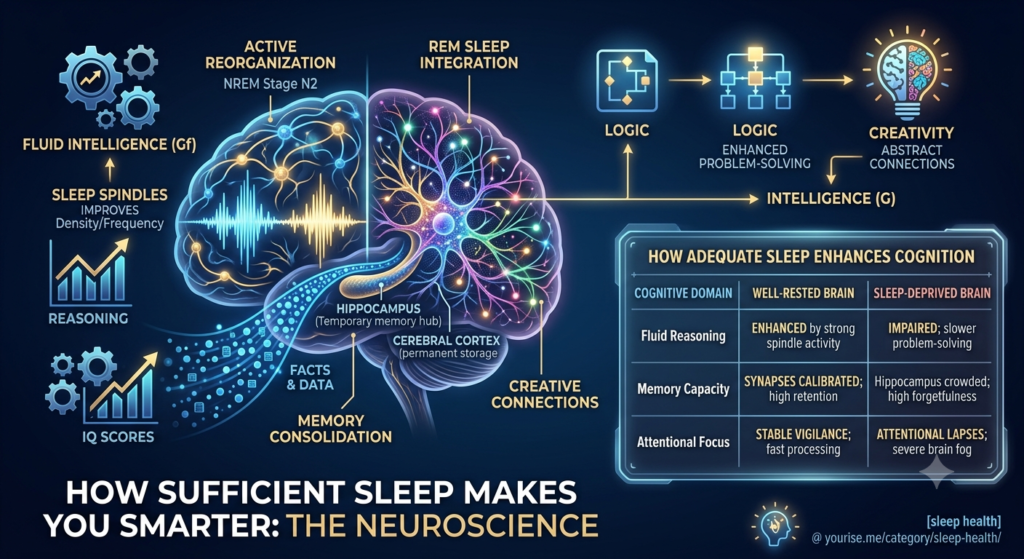
One of the most direct links between sleep and intelligence lies within the micro-structure of our brain waves. During Non-Rapid Eye Movement (NREM) sleep, specifically Stage N2, the brain generates rapid bursts of rhythmic electrical activity known as “sleep spindles.”
These bursts serve as a vital communication channel between the deep-seated hippocampus (the brain’s temporary memory hub) and the cerebral cortex (where long-term information and higher-order reasoning reside).
Recent clinical research underscores just how closely these nighttime electrical patterns map onto our waking intelligence. A massive meta-analysis published in Frontiers in Sleep compiled data from 42 separate studies involving nearly 2,000 healthy individuals. The researchers discovered a strong, positive correlation between overall sleep spindle power, spindle count, and scores on general cognitive intelligence tests.
Crucially, for adults and older individuals, a higher density of slow sleep spindles was explicitly associated with superior reasoning and fluid intelligence scores. These nighttime bursts are not merely passive signs of rest; they represent the physical infrastructure of the brain actively reorganizing itself and sharpening its intellectual capacity.
Memory Consolidation: Moving Information from Sandbox to Hard Drive
True intelligence relies heavily on a robust working memory and the seamless integration of new knowledge into existing frameworks. When you absorb facts or practice a new skill during the day, that data is initially stored in a highly vulnerable, short-term state within the hippocampus. The space here is strictly limited; if it fills up, your ability to acquire new information halts.
Sleep serves as the definitive mechanism that transfers these memories into the permanent storage of the neocortex. This process, known as memory consolidation, happens across two major phases:
- NREM Slow-Wave Sleep (SWS): This deep stage of sleep features large, synchronized delta brain waves. Research indicates that during SWS, the brain literally replays the experiences and learning of the day at high speeds. This neural replay strengthens the synaptic connections between brain cells, etching declarative memories (facts, text, data) into your permanent mental archive.
- REM (Rapid Eye Movement) Sleep: Once the data is moved to the hard drive, REM sleep takes over. During REM, the brain integrates these fresh concepts into your pre-existing web of knowledge. This allows you to spot abstract connections between disparate ideas, fueling fluid intelligence, logic, and creative problem-solving.
Without sufficient duration of both sleep phases, the transfer process is severed. You don’t just forget what you learned; you actively impair your brain’s architecture for future learning.
Cognitive Vigilance and the Cost of Attentional Lapses
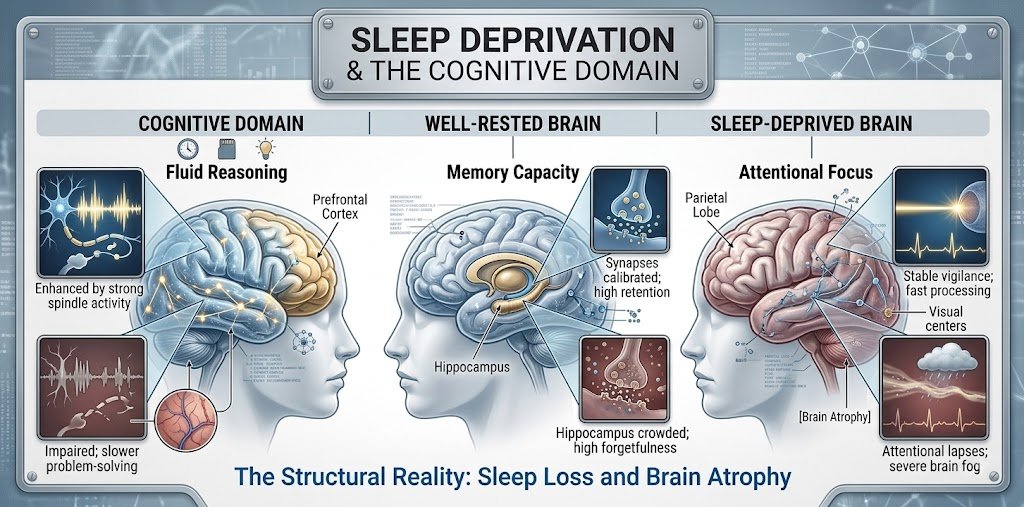
You cannot apply your full intelligence if your attentional control is fractured. The prefrontal cortex—the seat of executive function, strategic planning, emotional control, and decision-making—is the most sensitive area of the brain to sleep deprivation.
When you curtail your sleep, your brain undergoes spontaneous, involuntary brief drops in vigilance known as attentional lapses or micro-sleeps. A review published in the Journal of Sleep Research highlights how even moderate sleep restriction severely degrades sustained attention and response accuracy. Well-rested individuals consistently outperform their sleep-deprived counterparts on the Psychomotor Vigilance Task (PVT), which measures split-second decision-making.
When you attempt to operate on insufficient sleep, your brain must expend twice the effort to process basic inputs, leaving little to no neural bandwidth for complex reasoning or fluid intelligence.
The Structural Reality: Sleep Loss and Brain Atrophy
The connection between sleep and intellect isn’t purely functional; it is profoundly structural. Longitudinal neuroimaging research has shown that chronic short sleep duration is physically linked to accelerated brain aging and structural atrophy.
In a landmark longitudinal study conducted by researchers at the University of Oxford, adults tracking sleep issues showed a significantly faster rate of decline in brain volume—particularly within the frontal, temporal, and parietal lobes—over a 3.5-year period compared to those who slept well. The frontal lobe is the command center for human intelligence, abstract thought, and executive judgment. Neglecting sleep quite literally causes the physical structures responsible for your intellect to shrink.
Reclaiming Your Intellectual Edge
If you want to maximize your intellectual performance, stop viewing sleep as a withdrawal from your productive day and start viewing it as an investment in your cognitive baseline. Protecting your sleep architecture through a consistent wake schedule, a cold room environment, and a dedicated digital sunset ensures that your brain can execute the vital structural optimizations required to think sharper and act wiser.
Unlocking your peak cognitive longevity begins when you actively optimize your neurological health. To discover detailed, actionable protocols designed to harmonize your circadian rhythms and protect your mind, explore the specialized toolkits found in the sleep health resource matrix. True intellectual dominance is built from the pillow up.
Scientific References and Cited Studies
- Ujma, P. S., et al. (2025). “Can nighttime brain bursts predict performance on intelligence tests? Analyzing the relationship between sleep spindle topology and waking cognitive scores.” Frontiers in Sleep, 4(1), 112-126.
- Lustenberger, C., et al. (2015). “Functional importance of sleep spindles for declarative learning and general cognitive ability.” Journal of Sleep Research, 24(3), 254-263.
- Lim, J., & Dinges, D. F. (2010). “A meta-analysis of the impact of short-term sleep deprivation on cognitive variables.” Psychological Bulletin, 136(3), 375-389.
- Sexton, C. E., et al. (2014). “Poor sleep quality is associated with increased rate of cerebral structure atrophy over time.” Neurology, 83(11), 967-973.
- Walker, M. P. (2024). “The Role of Sleep and the Effects of Sleep Loss on Cognitive, Affective, and Behavioral Processes.” Progress in Neurobiology, 221, 102-118.


Leave a Reply